A new image from NASA’s Wide-field Infrared Survey Explorer, or WISE, shows the candle-like Flame nebula lighting up a cavern of dust. The Flame nebula is part of the Orion complex, a turbulent star-forming area located near the constellation’s star-studded belt.


The Flame Nebula sits on the eastern hip of Orion the Hunter, a constellation most easily visible in the …

Read the rest of this article

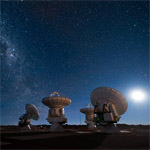
In northern Chile, at 16,500 feet above sea level, scientists from around the world are building the world’s largest radio telescope. When completed in 2013, sixty-six huge antennas – some weighing 115 tons – will stretch across a 10 square mile area of desert, point at the stars and try to unlock the secrets of the universe.

In this preview …

Read the rest of this article

AAVSO AAVSO Alert Notice 463
Nova Sagittarii 2012 No. 3 = PNV J17522579-2126215
July 3, 2012

Discovered independently by:
– Koichi Itagaki (Yamagata, Japan, reported by Hitoshi Yamaoka, Kyushu University)
– Yukio Sakurai (Mito, Ibaraki-ken, Japan)

Discovery Magnitude:
– Itagaki: magnitude 10.3 on an unfiltered CCD image taken with a 0.21-m reflector
– Sakurai: magnitude 9.9 on four 20-s frames taken …

Read the rest of this article

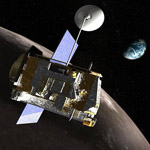
NASA’s Lunar Reconnaissance Orbiter (LRO) spacecraft has returned data that indicate ice may make up as much as 22 percent of the surface material in a crater located on the moon’s south pole.


Elevation (left) and shaded relief (right) image of Shackleton, a 21-km-diameter (12.5-mile-diameter) permanently shadowed crater adjacent to the lunar south pole. The structure of the crater’s interior …

Read the rest of this article

A favorite theme of science fiction is “the portal”–an extraordinary opening in space or time that connects travelers to distant realms. A good portal is a shortcut, a guide, a door into the unknown. If only they actually existed….

It turns out that they do, sort of, and a NASA-funded researcher at the University of Iowa has figured out how …

Read the rest of this article

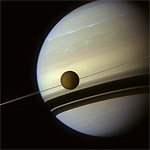
Saturn and Titan

Data from NASA’s Cassini spacecraft have revealed Saturn’s moon Titan likely harbors a layer of liquid water under its ice shell.

Researchers saw a large amount of squeezing and stretching as the moon orbited Saturn. They deduced that if Titan were composed entirely of stiff rock, the gravitational attraction of Saturn would cause bulges, or solid “tides,” on the moon …

Read the rest of this article

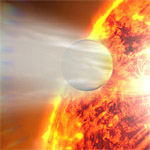
An international team of astronomers using data from NASA’s Hubble Space Telescope has made an unparalleled observation, detecting significant changes in the atmosphere of a planet located beyond our solar system.


The Hubble Space Telescope has discovered a planet, HD 189733b, that is losing some of it’s atmosphere every time a solar flare occurs. Credit: NASA GSFC

The scientists conclude …

Read the rest of this article

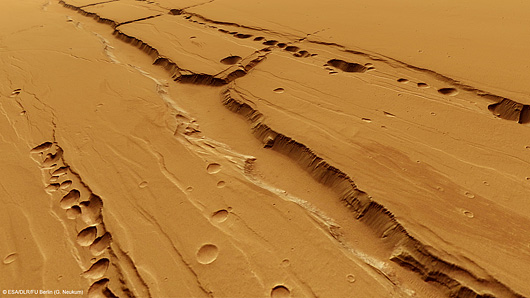
By studying rocks blasted out of impact craters, ESA’s Mars Express has found evidence that underground water persisted at depth for prolonged periods during the first billion years of the Red Planet’s existence.


The large 25 km-diameter crater in the foreground of this High Resolution Stereo Camera (HRSC) perspective view has excavated rocks which have been altered by groundwater in …

Read the rest of this article

Mars

A recent workshop conducted for NASA by the Lunar and Planetary Institute (LPI) in Houston, marked a key step in the agency’s effort to forge a new Mars strategy in the coming decades. A report that summarizes the wide range of cutting-edge science, technology and mission concepts discussed is available online.


NASA’s Mars Odyssey spacecraft passes above Mars’ south pole …

Read the rest of this article


Via: bpclaims.us

Read the rest of this article