AAVSO AAVSO Alert Notice 462
Monitoring of J1407 for next extrasolar ring system transit
June 26, 2012

Dr. Eric Mamajek (Cerro Tololo Interamerican Observatory and University of Rochester) has requested AAVSO observers’ assistance in monitoring the young star 1SWASP J140747.93-394542.6 to help determine the eclipse behavior related to a transiting ringed substellar companion.

This observing campaign begins now and continues until …

Read the rest of this article

Seeing is believing, except when you don’t believe what you see. Astronomers using NASA’s Hubble Space Telescope have found a puzzling arc of light behind an extremely massive cluster of galaxies residing 10 billion light-years away. The galactic grouping, discovered by NASA’s Spitzer Space Telescope, was observed as it existed when the universe was roughly a quarter of its current …

Read the rest of this article

Turbulent jet streams, regions where winds blow faster than in other places, churn east and west across Saturn. Scientists have been trying to understand for years the mechanism that drives these wavy structures in Saturn’s atmosphere and the source from which the jets derive their energy.

In a new study appearing in the June edition of the journal Icarus, scientists …

Read the rest of this article

For nearly 35 years, NASA’s Voyager 1 probe has been hurtling toward the edge of the solar system, flying through the dark void on a mission unlike anything attempted before. One day, mission controllers hope, Voyager 1 will leave the solar system behind and enter the realm of the stars—interstellar space.

That day may be upon us.


At the edge …

Read the rest of this article

Progress continues with Planetary Resources, the private syndicate that proposes to mine asteroids in the near future for rare metals. Here’s their latest communication:

We’ve been working our tails off at Planetary Resources planning our initial launches of our first spacecraft.

We call these first Asteroid finding spacecraft Arkyd Series-100 (next email we’ll tell you where the name ‘Arkyd’ comes …

Read the rest of this article

NASA

Eighty-four female high school students from 29 states will plan a simulated mission to Mars and experience life as an engineer or scientist when NASA’s Johnson Space Center in Houston hosts two events focused on science, technology, engineering and mathematics (STEM) in June and July.


Some of the next generation’s future female explorers and problem solvers got a real-world look …

Read the rest of this article

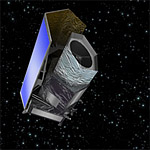
ESA’s Euclid mission to explore the hidden side of the Universe – dark energy and dark matter – reached an important milestone on June 20 that will see it head towards full construction.


Artist’s impression of Euclid. Credits: ESA – C. Carreau

Selected in October 2011 alongside Solar Orbiter as one of the first two medium-class missions of the Cosmic …

Read the rest of this article

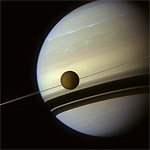
Saturn and Titan

Titan appears to be strung like a bead on Saturn’s rings, which cast shadows onto the southern hemisphere of the gas giant in this beautiful image from Cassini.


Titan and Saturn, seen when the Cassini spacecraft passed by Titan at a distance of 700, 000 km on 6 May 2012. The Cassini-–Huygens mission is a cooperative project of NASA, the …

Read the rest of this article

Black holes in the early universe needed a few snacks rather than one giant meal to fuel their quasars and help them grow, according to observations from NASA’s Spitzer and Hubble space telescopes.


The galaxies pictured here have so much dust surrounding them that the brilliant light from their quasars cannot be seen in these images NASA’s Hubble Space Telescope. …

Read the rest of this article

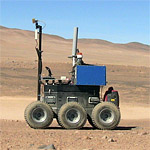
ESA assembled a top engineering team then challenged them to devise a way for rovers to navigate on alien planets. Six months later, a fully autonomous vehicle was charting its own course through Chile’s Mars-like Atacama Desert.


ESA’s Seeker rover during its May 2012 test campaign in Chile’s Atacama Desert, coasting along one of the rare flat loam deposits. The …

Read the rest of this article