Opportunity Mars Rover

With all the fanfare about Mars rover Curiosity landing on the Red Planet in August 2012, it’s easy to forget that there’s already a rover on Mars—an older, smaller cousin set to accomplish a feat unprecedented in the history of Solar System exploration.


More than 8 years after landing on the Red Planet, Mars rover Opportunity is still running. Indeed, …

Read the rest of this article

Watch live this weekend as an asteroid the size of a city block flies past the Earth.


Asteroid 4179 Toutatis passed by the Earth in 2004. Credit: ESO

On Sunday, July 22, there will have a live feed from the Slooh Space Camera. The show will start at 4:30 p.m. Pacific (7:30 p.m. Eastern) with images from the Slooh …

Read the rest of this article

AAVSO AAVSO Alert Notice 465
Nova Sagittarii 2012 No. 5 = PSN J18193700-1907400
July 20, 2012

Discovered by: Tadashi Kojima (Tsumagoi, Agatsuma-gun, Gunma-ken, Japan) (reported by S. Nakano (Sumoto, Japan)

Discovery Magnitude: mag 12.6 on two frames using a Canon EOS 40D camera (+ 150-mm f/2.8 lens)

Discovery date: 2012 July 16.512 UT

Coordinates: R.A. 18 19 37.0 Decl. -19 07 …

Read the rest of this article

Astronomers using NASA’s Spitzer Space Telescope have detected what they believe is a planet two-thirds the size of Earth. The exoplanet candidate, called UCF-1.01, is located a mere 33 light-years away, making it possibly the nearest world to our solar system that is smaller than our home planet.


This artist’s concept shows what astronomers believe is an alien world just …

Read the rest of this article

If you want to talk big scientific breakthroughs, how about quasars and supernovae?

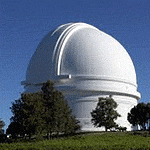
Those are just two of the most important discoveries in the long, very storied history of the Palomar Observatory, a set of telescopes and other astronomical instruments located at the top of this mountain northeast of San Diego. And while the facility no longer holds quite the …

Read the rest of this article

ESA astronaut Tim Peake recently spent 12 days underwater with three other aquanauts to look at the best ways for astronauts to explore an asteroid. Behind the scenes, a large support team was learning through experience.

No effort was spared to make the experience as realistic as possible. This Neemo mission simulated a mission to an asteroid 15 million km …

Read the rest of this article

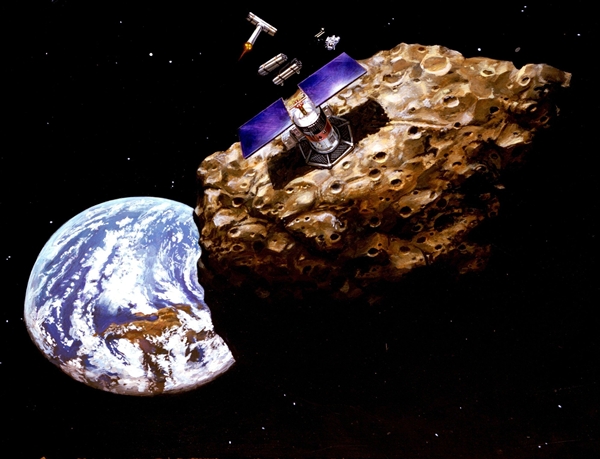
In 2011, a University of Bristol (UK) study determined that the Earth’s reserve of rare earth metals came from a meteorite bombardment that happened 200 million years ago.

The Earth itself was formed 4.5 billion years ago and, at that time, was a molten ball of rack and metal. With iron being heavier than rock, it sank to the center …

Read the rest of this article

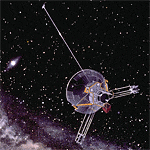
The unexpected slowing of NASA’s Pioneer 10 and 11 spacecraft  – the so-called “Pioneer Anomaly” – turns out to be due to the slight, but detectable effect of heat pushing back on the spacecraft, according to a recent paper. The heat emanates from electrical current flowing through instruments and the thermoelectric power supply.  The results were published on June 12 …

Read the rest of this article

NASA’s most advanced planetary rover is on a precise course for an early August landing beside a Martian mountain to begin two years of unprecedented scientific detective work. However, getting the Curiosity rover to the surface of Mars will not be easy.


The area where NASA’s Curiosity rover will land on Aug. 5 PDT (Aug. 6 EDT) has a geological …

Read the rest of this article

Is it a magnetar or is it a pulsar? A second member of a rare breed of dead, spinning star has been identified thanks to an armada of space-based X-ray telescopes, including ESA’s XMM-Newton. Its curious behaviour is illustrated in this animation.


Animation illustrating the behaviour of recently discovered Swift J1822.3–1606, a ‘low-field magnetar’ with an intense internal magnetic field …

Read the rest of this article