This new view of spiral galaxy IC 342, also known as Caldwell 5, includes data from NASA’s Nuclear Spectroscopic Telescope Array, or NuSTAR. High-energy X-ray data from NuSTAR have been translated to the color magenta, and superimposed on a visible-light view highlighting the galaxy and its star-studded arms. NuSTAR is the first orbiting telescope to take focused pictures of the …

Read the rest of this article


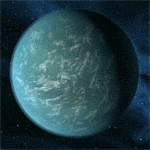
This collage includes a compilation of artist’s concepts depicting milestones from the Kepler mission. Image credit: NASA Ames Research Center/W. Stenzel

NASA’s Kepler mission Monday announced the discovery of 461 new planet candidates. Four of the potential new planets are less than twice the size of Earth and orbit in their sun’s “habitable zone,” the region in the planetary system …

Read the rest of this article

NASA is exploring options for innovative and imaginative uses of two large space telescopes recently transferred to the agency. In a request for information (RFI) published Monday, NASA seeks information about system concepts and architectures that would take advantage of these assets to address NASA’s goals in astrophysics, heliophysics, planetary sciences, and human spaceflight.

“Because there are two telescopes, there …

Read the rest of this article

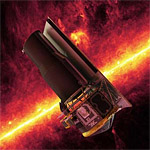
NASA is marking two milestones in the search for planets like Earth; the successful completion of the Kepler Space Telescope’s three-and-a-half-year prime mission and the beginning of an extended mission that could last as long as four years.


This artist’s concept shows the Kepler spacecraft.

Scientists have used Kepler data to identify more than 2,300 planet candidates and confirm more …

Read the rest of this article

Astronomers using NASA’s Spitzer Space Telescope have announced the most precise measurement yet of the Hubble constant, or the rate at which our universe is stretching apart.


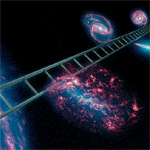
Astronomers using NASA’s Spitzer Space Telescope have greatly improved the cosmic distance ladder used to measure the expansion rate of the universe, as well as its size and age. The cosmic distance ladder, …

Read the rest of this article

What would you do if you had access to Planetary Resources’ Arkyd-100 space telescopes?

Dr. Vlada Stamenkovic, a post-doctoral researcher at MIT who works on exoplanets – distant alien worlds beyond our solar system – has a great answer in this video:

It’s inspiring to think that the Arkyd can help researchers like Vlada discover Earth-like planets, and perhaps, …

Read the rest of this article

The European Space Agency (ESA) has announced the winners of an international public contest called Hubble’s Hidden Treasures.

Budding amateur astronomers were invited to create beautiful color astronomical pictures from over 700,000 available images of stars, nebulae, and galaxies in the Hubble Space Telescope data archive. The vast amount of data available from Hubble means that there are at …

Read the rest of this article

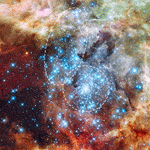
Astronomers using data from NASA’s Hubble Space Telescope have caught two clusters full of massive stars that may be in the early stages of merging. The clusters are 170,000 light-years away in the Large Magellanic Cloud, a small satellite galaxy to our Milky Way.


This is a Hubble Space Telescope image of a pair of star clusters that are believed …

Read the rest of this article

Is it a magnetar or is it a pulsar? A second member of a rare breed of dead, spinning star has been identified thanks to an armada of space-based X-ray telescopes, including ESA’s XMM-Newton. Its curious behaviour is illustrated in this animation.


Animation illustrating the behaviour of recently discovered Swift J1822.3–1606, a ‘low-field magnetar’ with an intense internal magnetic field …

Read the rest of this article

Seeing is believing, except when you don’t believe what you see. Astronomers using NASA’s Hubble Space Telescope have found a puzzling arc of light behind an extremely massive cluster of galaxies residing 10 billion light-years away. The galactic grouping, discovered by NASA’s Spitzer Space Telescope, was observed as it existed when the universe was roughly a quarter of its current …

Read the rest of this article