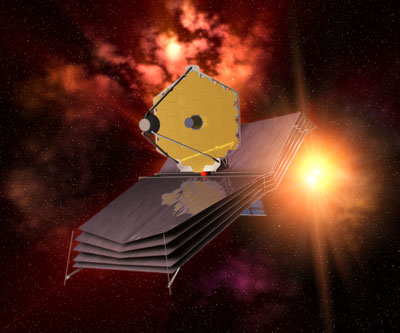
ESA’s Euclid mission to explore the hidden side of the Universe – dark energy and dark matter – reached an important milestone on June 20 that will see it head towards full construction.


Artist’s impression of Euclid. Credits: ESA – C. Carreau

Selected in October 2011 alongside Solar Orbiter as one of the first two medium-class missions of the Cosmic …

Read the rest of this article

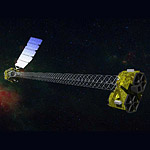
NASA’s Nuclear Spectroscopic Telescope Array (NuSTAR) launched into the morning skies over the central Pacific Ocean at noon EDT (9 a.m. PDT) Wednesday, beginning its mission to unveil secrets of buried black holes and other exotic objects.


NuSTAR has a 30-foot mast that deploys after launch to separate the optics modules (right) from the detectors in the focal plane (left). …

Read the rest of this article

The Sun

During a powerful solar blast on March 7, NASA’s Fermi Gamma-ray Space Telescope detected the highest-energy light ever associated with an eruption on the sun. The discovery heralds Fermi’s new role as a solar observatory, a powerful new tool for understanding solar outbursts during the sun’s maximum period of activity.


During a powerful solar blast in March, NASA’s Fermi Gamma-ray …

Read the rest of this article

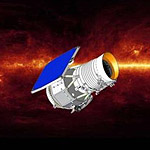
Astronomers are getting to know the neighbors better. Our sun resides within a spiral arm of our Milky Way galaxy about two-thirds of the way out from the center. It lives in a fairly calm, suburb-like area with an average number of stellar residents. Recently, NASA’s Wide-field Infrared Survey Explorer, or WISE, has been turning up a new crowd of …

Read the rest of this article

The faint, lumpy glow given off by the very first objects in the universe may have been detected with the best precision yet, using NASA’s Spitzer Space Telescope. These faint objects might be wildly massive stars or voracious black holes. They are too far away to be seen individually, but Spitzer has captured new, convincing evidence of what appears to …

Read the rest of this article

Giant bubbles, towering pillars and cascading clouds of dust and gas fill the star-forming nursery of the Carina Nebula seen here in a stunning new view from Herschel to launch ESA Space Science’s image of the week feature.


The Carina Nebula, by ESA’s Herschel space observatory. The image (enlarged view) shows the effects of massive star formation – …

Read the rest of this article

NASA’s Nuclear Spectroscopic Telescope Array, or NuSTAR, is being prepared for the final journey to its launch pad on Kwajalein Atoll in the central Pacific Ocean. The mission will study everything from massive black holes to our own sun. It is scheduled to launch no earlier than June 13.


NASA’s Nuclear Spectroscopic Telescope Array, or NuSTAR, has a complex set …

Read the rest of this article

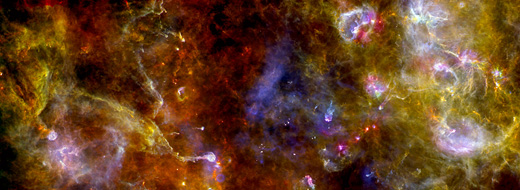
Chaotic networks of dust and gas signpost the next generations of massive stars in this stunning new image of the Cygnus-X star-nursery captured by ESA’s Herschel space observatory.


This new view of the Cygnus-X star-formation region by Herschel highlights chaotic networks of dust and gas that point to sites of massive star formation (click for larger image). The …

Read the rest of this article

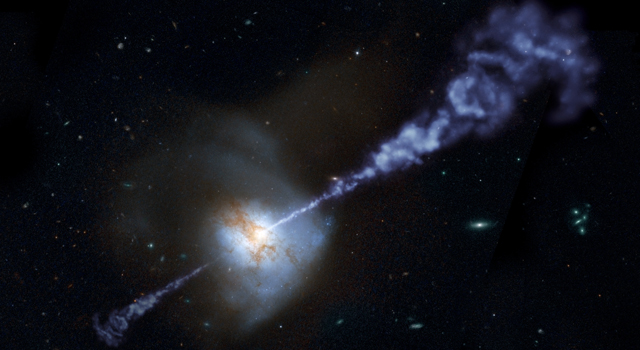
The Herschel Space Observatory has shown galaxies with the most powerful, active black holes at their cores produce fewer stars than galaxies with less active black holes. The results are the first to demonstrate black holes suppressed galactic star formation when the universe was less than half its current age.


This artistically modified image of the local galaxy Arp 220, …

Read the rest of this article

The first instrument to be completed for the James Webb Space Telescope, MIRI, was handed over by the European consortium that built it to ESA at a ceremony held in London today, and will now be delivered to NASA aiming for launch in 2018.


MIRI, the Mid Infrared Instrument, being prepared for vibration testing at the Science and Technology Facilities …

Read the rest of this article