Gaia, ESA’s billion-star surveyor, will be launched into space towards the end of this year. In the meantime, ESA Space Science has launched a new ‘minisite’ focused on the Gaia mission.

Loading…


jwplayer("pi_player").setup({ 'dock': 'true', 'image': 'http://spaceinvideos.esa.int/var/esa/storage/images/esa_multimedia/videos/2013/06/gaia_sunshade_deployment/12880145-3-eng-GB/Gaia_sunshade_deployment_video_production_full.png', 'wmode': 'transparent', 'height': '325', 'width': '520', 'controlbar': 'bottom', 'quality': 'true', 'modes': [ { 'type': 'flash', 'src': 'http://spaceinvideos.esa.int/extension/esadam/design/standard/flash/player.swf', 'config': { 'file': 'mp4:download/public/videos/2013/06/010/1306_010_AR_EN.mp4', 'streamer': 'rtmp://fms.50E6.edgecastcdn.net/8050E6/multimedia-delivery.esa.int', …

Read the rest of this article

With the exhaustion of its helium coolant, Herschel’s science mission ended on 29 April. But the stalwart satellite continued providing value to the end, serving as an orbiting testbed for control techniques that can’t normally be tested in flight.


Martin Kessler, Head of ESA’s Science Operations Department, sends the final command to Herschel at 12:25 GMT (14:25 CEST), 17 June …

Read the rest of this article

Alien planets are out there and Planetary Resources needs your help to find them! That’s right, the same high-powered telescope technology being used by Planetary Resources to identify near-Earth asteroids can also be used to hunt for what scientists call extrasolar planets or “exoplanets” – which are very much alien worlds. For the first-time ever, this capability will be placed …

Read the rest of this article

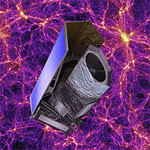
The module carrying the telescope and scientific instruments of ESA’s Euclid ‘dark Universe’ mission is now being developed by Astrium in Toulouse, France.

Euclid will be launched in 2020 to explore dark energy and dark matter in order to understand the evolution of the Universe since the Big Bang and, in particular, its present accelerating expansion.


Artist impression of Euclid. …

Read the rest of this article

The Herschel observatory, a European space telescope for which NASA helped build instruments and process data, has stopped making observations after running out of liquid coolant as expected.

The European Space Agency mission, launched almost four years ago, revealed the universe’s “coolest” secrets by observing the frigid side of planet, star and galaxy formation.

“Herschel gave us the opportunity to …

Read the rest of this article

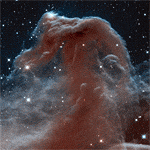
New views of the Horsehead Nebula and its turbulent environment have been unveiled by ESA’s Herschel space observatory and the NASA/ESA Hubble space telescope.


Stunning new view from ESA’s Herschel space observatory of the iconic Horsehead Nebula in the context of its surroundings. The image is a composite of the wavelengths of 70 microns (blue), 160 microns (green) and 250 …

Read the rest of this article

NASA’s Kepler mission has discovered two new planetary systems that include three super-Earth-size planets in the “habitable zone,” the range of distance from a star where the surface temperature of an orbiting planet might be suitable for liquid water.


The artist’s concept depicts Kepler-62f, a super-Earth-size planet in the habitable zone of a star smaller and cooler than the sun, …

Read the rest of this article

Acquired by ESA’s Planck space telescope, the most detailed map ever created of the cosmic microwave background – the relic radiation from the Big Bang – was released yesterday revealing the existence of features that challenge the foundations of our current understanding of the Universe.

The image is based on the initial 15.5 months of data from Planck and is …

Read the rest of this article

Astronomers have found some of the youngest stars ever seen, thanks to the Herschel space observatory, a European Space Agency mission with important NASA contributions.

Observations from NASA’s Spitzer Space Telescope and the Atacama Pathfinder Experiment (APEX) telescope in Chile, a collaboration involving the Max Planck Institute for Radio Astronomy in Germany, the Onsala Space Observatory in Sweden, and the …

Read the rest of this article

Chandra X-Ray Observatory

Unlike with some blockbuster films, the sequel to a movie from NASA’s Chandra X-ray Observatory is better than the first. This latest movie features a deeper look at a fast moving jet of particles produced by a rapidly rotating neutron star, and may provide new insight into the nature of some of the densest matter in the universe.

The hero …

Read the rest of this article