NASA’s Kepler mission has discovered the first Earth-size planets orbiting a sun-like star outside our solar system. The planets, called Kepler-20e and Kepler-20f, are too close to their star to be in the so-called habitable zone where liquid water could exist on a planet’s surface, but they are the smallest exoplanets ever confirmed around a star like our sun.
Kepler Mission Discovers First Earth-Size Planets Beyond Our Solar System
ESA Gaia Star Mapper Spreads Its Wings
ESA’s Gaia star-mapper has passed a critical test ahead of its launch in 2013: the spacecraft’s sunshield has been deployed for the first time.
Gaia’s sunshield is an essential component of the mission. It keeps Gaia in shadow, maintaining the scientific instruments at a constant temperature of around –110°C.
The Camtasia Studio video content presented here requires a more recent … Read the rest of this article
Dawn Spacecraft Images Show Vesta’s ‘Color Palette’
Vesta appears in a splendid rainbow-colored palette in new images obtained by NASA’s Dawn spacecraft. The colors, assigned by scientists to show different rock or mineral types, reveal Vesta to be a world of many varied, well-separated layers and ingredients. Vesta is unique among asteroids visited by spacecraft to date in having such wide variation, supporting the notion that it … Read the rest of this article
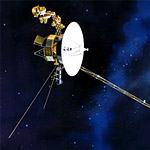
NASA’s Voyager 1 spacecraft has entered a new region between our solar system and interstellar space. Data obtained from Voyager over the last year reveal this new region to be a kind of cosmic purgatory. In it, the wind of charged particles streaming out from our sun has calmed, our solar system’s magnetic field is piled up, and higher-energy particles … Read the rest of this article
NASA’s New Horizons Becomes the Closest Spacecraft to Approach Pluto
NASA’s New Horizons mission reached a special milestone yesterday, Dec. 2, 2011, on its way to reconnoiter the Pluto system, coming closer to Pluto than any other spacecraft.
It’s taken New Horizons 2,143 days of high-speed flight – covering more than a million kilometers per day for nearly six years—to break the closest-approach mark of 1.58 billion kilometers set by … Read the rest of this article
ESA astronauts joined Google and YouTube managers on 30 November at the European Astronaut Centre, Cologne, to present highlights of the ‘Space Lab’ competition.
Watch a replay of the webcast recording below. The programme runs about 80 minutes.
eurospaceagency on livestream.com. Broadcast Live FreeLISA Pathfinder Takes Major Step in Hunt for Gravity Waves
Sensors destined for ESA’s LISA Pathfinder mission in 2014 have far exceeded expectations, paving the way for a mission to detect one of the most elusive forces permeating through space – gravity waves.
LISA Pathfinder about to enter the space environment vacuum test. Credits: Astrium UK
The Optical Metrology Subsystem underwent its first full tests under space-like temperature and vacuum … Read the rest of this article
What Is Our Future in Space?
In July 2011, at the JREF’s TAM 9 meeting in Las Vegas, astronomer Phil Plait moderated a panel discussing the future of space exploration. On that panel were some familiar faces: Bill Nye (the Science Guy), astronomers Neil Tyson and Pamela Gay, and theoretical physicist Lawrence Krauss.
The video of the panel has been made available by the JREF, so … Read the rest of this article
China Launches Space Module Rocket Tiangong 1
China has launched a rocket marking its first step towards building its own space station. Tiangong 1 was launched from the Gobi Desert. The space module lab is called “Heavenly Palace” or Tiangong 1 and will remain in orbit for docking missions
It is a mission that is generating huge national pride and is being seen as a symbol of … Read the rest of this article
- « Previous Page
- 1
- …
- 4
- 5
- 6
- 7
- 8
- …
- 11
- Next Page »