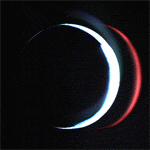
The sight of the crescent Moon hanging in the sky above Earth is a familiar one, but this image taken by ESA’s Rosetta spacecraft as it passed by the Red Planet in February 2007 captures the rare view of a skinny slice of Mars.


A thin crescent Mars (white) captured by Rosetta’s OSIRIS (Optical, Spectrocopic and Infrared Remote Imaging System) …

Read the rest of this article

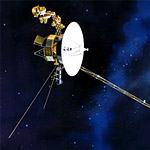
Thirty-five years ago today, NASA’s Voyager 2 spacecraft, the first Voyager spacecraft to launch, departed on a journey that would make it the only spacecraft to visit Uranus and Neptune and the longest-operating NASA spacecraft ever. Voyager 2 and its twin, Voyager 1, that launched 16 days later on Sept. 5, 1977, are still going strong, hurtling away from our …

Read the rest of this article

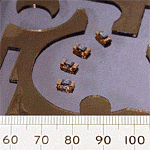
Thanks to ideas of putting swarms of tiny robot bugs to work on a future space station, patients being medicated for blood clots may soon get a simple, home-use testing kit, here on Earth.


This image of the International Space Station with the docked Europe’s ATV Johannes Kepler and Space Shuttle Endeavour was taken by ESA astronaut Paolo Nespoli from …

Read the rest of this article

Two of three key signs of changes expected to occur at the boundary of interstellar space have changed faster than at any other time in the last seven years, according to new data from NASA’s Voyager 1 spacecraft.


This artist’s concept shows NASA’s two Voyager spacecraft exploring a turbulent region of space known as the heliosheath, the outer shell of …

Read the rest of this article

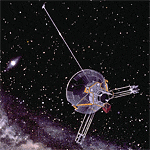
The unexpected slowing of NASA’s Pioneer 10 and 11 spacecraft  – the so-called “Pioneer Anomaly” – turns out to be due to the slight, but detectable effect of heat pushing back on the spacecraft, according to a recent paper. The heat emanates from electrical current flowing through instruments and the thermoelectric power supply.  The results were published on June 12 …

Read the rest of this article

For nearly 35 years, NASA’s Voyager 1 probe has been hurtling toward the edge of the solar system, flying through the dark void on a mission unlike anything attempted before. One day, mission controllers hope, Voyager 1 will leave the solar system behind and enter the realm of the stars—interstellar space.

That day may be upon us.


At the edge …

Read the rest of this article

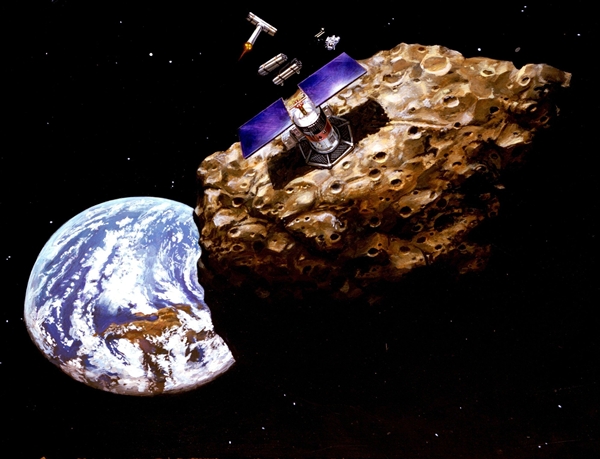
Just received this statement from Planetary Resources about what’s been happening since they announced the formation of their company a few weeks ago, so things are progressing:

If you’re like us, you’ve always had a life-long dream to open the space frontier.

We’re not just talking about taking a few people into orbit, but opening the resources of space, to …

Read the rest of this article

NASA’s Dawn spacecraft has provided researchers with the first orbital analysis of the giant asteroid Vesta, yielding new insights into its creation and kinship with terrestrial planets and Earth’s moon.


This image, made from data obtained by NASA’s Dawn spacecraft, shows the mineral distribution in the southern hemisphere of the giant asteroid Vesta. The mineral data came from Dawn’s visible …

Read the rest of this article

Seattle, Wash. – April 24, 2012 — Planetary Resources, Inc. announced today its plan to mine Near-Earth Asteroids (NEAs) for raw materials, ranging from water to precious metals. Through the development of cost-effective exploration technologies, the company is poised to initiate prospecting missions targeting resource-rich asteroids that are easily accessible.

Resource extraction from asteroids will deliver multiple benefits to humanity …

Read the rest of this article

Following on from my post a couple of days ago about how a number of Tech Billionaires and high-flyers have gotten together to create a private space program, I came across this article which provides a lot more detail about their plans…

There’s gold in them there hills. You know, those ones floating around in space. Asteroids contain many tons …

Read the rest of this article