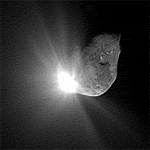
NASA’s Stardust spacecraft returned new images of a comet showing a scar resulting from the 2005 Deep Impact mission. The images also showed the comet has a fragile and weak nucleus.

The spacecraft made its closest approach to comet Tempel 1 on Monday, Feb. 14, at 8:40 p.m. PST (11:40 p.m. EST) at a distance of approximately 178 kilometers (111 …

Read the rest of this article

Mission controllers at NASA’s Jet Propulsion Laboratory, Pasadena, Calif., watched as data downlinked from the Stardust spacecraft indicated it completed its closest approach with comet Tempel 1. An hour after closest approach, the spacecraft turned to point its large, high-gain antenna at Earth. It is expected that images of the comet’s nucleus collected during the flyby will be received on …

Read the rest of this article

NASA is about to discover how solar heat devours a comet.


Stardust-NExT chases a comet, an artist’s concept. [more]

“For the first time, we’ll see the same comet before and after its closest approach to the sun,” explains Joe Veverka, principal investigator for NASA’s Stardust-NExT mission.

The comet is Tempel 1, which NASA’s Deep Impact probe visited in …

Read the rest of this article

It’s a calm and peaceful night. Stars twinkle in the velvety darkness overhead as a distant plane blinks silently on the horizon. You could almost hear a pin drop.


A camera in Finland caught NanoSail-D flaring on Jan. 30th. The streak of light was almost three times brighter than a 1st-magnitude star. Credit: Esko Lyytinen. [details]

That is, …

Read the rest of this article

In an unexpected reversal of fortune, NASA’s NanoSail-D spacecraft has unfurled a gleaming sheet of space-age fabric 650 km above Earth, becoming the first-ever solar sail to circle our planet.

“We’re solar sailing!” says NanoSail-D principal investigator Dean Alhorn of the Marshall Space Flight Center in Huntsville, AL. “This is a momentous achievement.”


An artist’s concept of a solar sail …

Read the rest of this article

Key components of the ESA-led Mercury mapper BepiColombo have been tested in a specially upgraded European space simulator. ESA’s Large Space Simulator is now the most powerful in the world and the only facility capable of reproducing Mercury’s hellish environment for a full-scale spacecraft.


BepiColombo’s Mercury Magnetospheric Orbiter (MMO) in the Large Space Simulator at ESTEC, The Netherlands. The octagonal …

Read the rest of this article


Kepler confirmed the discovery of its first rocky planet. Measuring 1.4 times the size of Earth, it is the smallest planet ever discovered outside our solar system.

NASA’s Kepler mission confirmed the discovery of its first rocky planet, named Kepler-10b. Measuring 1.4 times the size of Earth, it is the smallest planet ever discovered outside our solar system.

The discovery …

Read the rest of this article

The 33-year odyssey of NASA’s Voyager 1 spacecraft has reached a distant point at the edge of our solar system where there is no outward motion of solar wind.

Now hurtling toward interstellar space some 10.8 billion miles from the sun, Voyager 1 has crossed into an area where the velocity of the hot ionized gas, or plasma, emanating directly …

Read the rest of this article

NASA’s EPOXI mission spacecraft successfully flew past comet Hartley 2 at 10 a.m. EDT Thursday. Scientists say initial images from the flyby provide new information about the comet’s volume and material spewing from its surface.

The following is a statement from NASA Administrator Charles Bolden on the EPOXI mission’s successful flyby of comet Hartley 2:

“NASA extended its pioneering exploration …

Read the rest of this article

A pair of NASA spacecraft that were supposed to be dead a year ago are instead flying to the Moon for a breakthrough mission in lunar orbit.

“Their real names are THEMIS P1 and P2, but I call them ‘dead spacecraft walking,'” says Vassilis Angelopoulos of UCLA, principal investigator of the THEMIS mission. “Not so long ago, we thought they …

Read the rest of this article