To mark an unprecedented flurry of exploration which is about to begin, NASA announced today that the coming year will be “The Year of the Solar System” (YSS).

“During YSS, we’ll see triple the [usual] number of launches, flybys and orbital insertions,” says Jim Green, Director of Planetary Science at NASA headquarters. “There hasn’t been anything quite like it in …

Read the rest of this article

NASA’s Kepler mission Science Operations Center software system was named winner of the 2010 NASA Software of the Year Award by the NASA Software Advisory Panel.

Designed, developed and operated by the Kepler Science Operations Center (SOC) at NASA’s Ames Research Center in Moffett Field, Calif., the SOC software system is used to find Earth-size planets using photometric data acquired …

Read the rest of this article

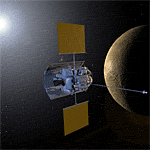
The first spacecraft designed by NASA to orbit Mercury is giving scientists a new perspective on the planet’s atmosphere and evolution.

Launched in August 2004, the Mercury Surface, Space Environment, Geochemistry and Ranging spacecraft, known as MESSENGER, conducted a third and final flyby of Mercury in September 2009. The probe completed a critical maneuver using the planet’s gravity to remain …

Read the rest of this article

Asteroid Lutetia has been revealed as a battered world of many craters. ESA’s Rosetta mission has returned the first close-up images of the asteroid showing it is most probably a primitive survivor from the violent birth of the Solar System.

The flyby was a spectacular success with Rosetta performing faultlessly. Closest approach took place at 18:10 CEST on July 10th, …

Read the rest of this article

NASA successfully launched the Lunar Crater Observation and Sensing Satellite, or LCROSS, Thursday on a mission to search for water ice in a permanently shadowed crater at the moon’s south pole. The satellite lifted off on an Atlas V rocket from Cape Canaveral Air Force Station, Fla., at 5:32 p.m. EDT, with a companion mission, the Lunar Reconnaissance Orbiter, or …

Read the rest of this article


An artist’s concept of New Horizons.

Zipping through space at nearly a million miles per day, NASA’s New Horizons probe is halfway to Pluto and just woke up for the first time in months to look around.

“Our spacecraft is way out in exotic territory, in the middle of nowhere,” says Hal Weaver, New Horizons project scientist at Johns Hopkins …

Read the rest of this article

SpaceX’s Falcon 9 rocket launched successfully today and achieved orbit after an abort earlier in the day. Following the cancellation of further development on NASA’s Constellation manned space vehicles, SpaceX received a sizeable investment from NASA to further develop their line of privately owned launchers.

The Falcon 9 is a two stage, liquid oxygen and rocket grade kerosene (RP-1) powered …

Read the rest of this article


This figure shows the volcanic peak Idunn Mons (at 46°S, 214.5°E) in the Imdr Regio area of Venus. The topography derives from data obtained by NASA’s Magellan spacecraft, with a vertical exageration of 30 times. Radar data (in brown) from Magellan has been draped on top of the topographic data. Bright areas are rough or have steep slopes. Dark areas

Read the rest of this article

On Monday, Jan. 14, a pioneering NASA spacecraft was the first to visit Mercury in almost 33 years when it soared over the planet to explore and snap close-up images of never-before-seen terrain. These findings could open new theories and answer old questions in the study of the solar system.

The MErcury Surface, Space ENvironment, GEochemistry, and Ranging spacecraft, called …

Read the rest of this article

The LCROSS mission operations team initiated power-up of the LCROSS science payload and saw this view of the moon.

NASA’s Lunar Crater Observation and Sensing Satellite, or LCROSS, created twin impacts on the moon’s surface early on October 9, 2009 in a search for water ice. Scientists will analyze data from the spacecraft’s instruments to assess whether water ice is …

Read the rest of this article