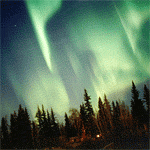
This dramatic panorama shows a colourful, shimmering auroral curtain reflected in a placid Icelandic lake. The image was taken on 18 March 2015 by Carlos Gauna, near Jökulsárlón Glacier Lagoon in southern Iceland.

The celestial display was generated by a coronal mass ejection, or CME – a massive eruption on the Sun – on 15 March. A flotilla of Sun-watching …

Read the rest of this article
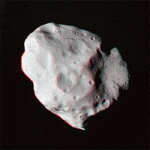
On Dec. 3, the Japan Aerospace Exploration Agency (JAXA) successfully launched its Hayabusa2 mission to rendezvous with an asteroid, land a small probe plus three mini rovers on its surface, and then return samples to Earth. NASA and JAXA are cooperating on the science of the mission and NASA will receive a portion of the Hayabusa2 sample in exchange for …

Read the rest of this article
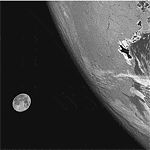
Mars

Thanks to a break in the dusty ‘weather’ over the giant Hellas Basin at the beginning of this year, ESA’s Mars Express was able to look down into the seven kilometre-deep basin and onto the frosty surface of Hellas Chaos.

Hellas Basin sits in the southern highlands of Mars and is one of the Solar System’s largest impact basins, with …

Read the rest of this article

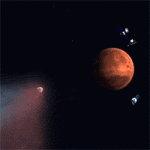
NASA’s extensive fleet of science assets, particularly those orbiting and roving Mars, have front row seats to image and study a once-in-a-lifetime comet flyby on Sunday, Oct. 19.

Comet C/2013 A1, also known as comet Siding Spring, will pass within about 87,000 miles (139,500 kilometers) of the Red Planet — less than half the distance between Earth and our moon …

Read the rest of this article

After a decade-long journey chasing its target, ESA’s Rosetta has today become the first spacecraft to rendezvous with a comet, opening a new chapter in Solar System exploration.

Comet 67P/Churyumov–Gerasimenko and Rosetta now lie 405 million kilometres from Earth, about half way between the orbits of Jupiter and Mars, rushing towards the inner Solar System at nearly 55 000 kilometres …

Read the rest of this article

NASA is taking steps to protect its Mars orbiters, while preserving opportunities to gather valuable scientific data, as Comet C/2013 A1 Siding Spring heads toward a close flyby of Mars on Oct. 19.

The comet’s nucleus will miss Mars by about 82,000 miles (132,000 kilometers), shedding material hurtling at about 35 miles (56 kilometers) per second, relative to Mars and …

Read the rest of this article

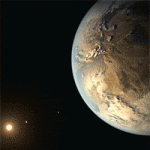
Using NASA’s Kepler Space Telescope, astronomers have discovered the first Earth-size planet orbiting a star in the “habitable zone” — the range of distance from a star where liquid water might pool on the surface of an orbiting planet. The discovery of Kepler-186f confirms that planets the size of Earth exist in the habitable zone of stars other than our …

Read the rest of this article

Rosetta Mission

Comets are among the most beautiful and least understood nomads of the night sky. To date, half a dozen of these most heavenly of heavenly bodies have been visited by spacecraft in an attempt to unlock their secrets. All these missions have had one thing in common: the high-speed flyby. Like two ships passing in the night (or one ship …

Read the rest of this article
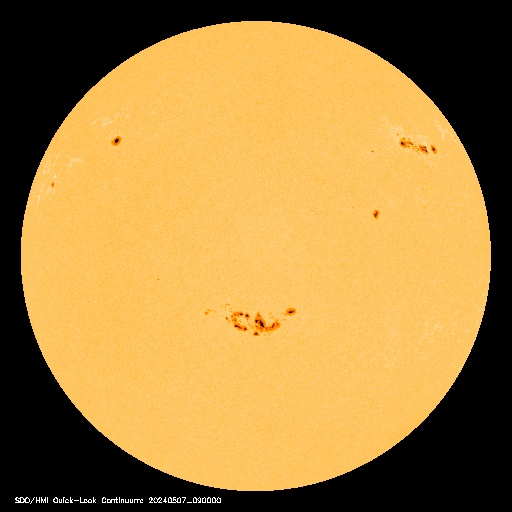
When NASA’s Juno spacecraft flew past Earth on Oct. 9, 2013, it received a boost in speed of more than 8,800 mph (about 7.3 kilometer per second), which set it on course for a July 4, 2016, rendezvous with Jupiter, the largest planet in our solar system. One of Juno’s sensors, a special kind of camera optimized to track faint …

Read the rest of this article
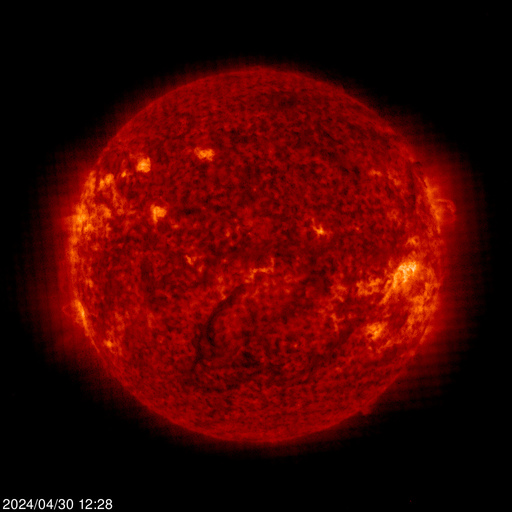
Hopes are high for Comet ISON, which has the potential to become the most spectacular comet seen in years. ISON is speeding through the inner solar system at about 120,000 miles per hour, on its way to a close approach to the Sun on November 28th. Assuming it survives its close encounter, it could become easily visible to the unaided …

Read the rest of this article