|
|

NASA’s Solar Dynamics Observatory, or SDO, lifted off Thursday from Cape Canaveral Air Force Station’s Launch Complex 41 on a first-of-a-kind mission to reveal the sun’s inner workings in unprecedented detail. The launch aboard an Atlas V rocket occurred at 10:23 a.m. EST.
The most technologically advanced of NASA’s heliophysics spacecraft, SDO will take images of the sun every 0.75 seconds and daily send back about 1.5 terabytes of data to Earth — the equivalent of streaming 380 full-length movies.
“This is going to be sensational,” said Richard R. Fisher, director of the Heliophysics Division at NASA Headquarters in Washington. “SDO is going to make a huge step forward in our understanding of the sun and its effects on life and society.”
The sun’s dynamic processes affect everyone and everything on Earth. SDO will explore activity on the sun that can disable satellites, cause power grid failures, and disrupt GPS communications. SDO also will provide a better understanding of the role the sun plays in Earth’s atmospheric chemistry and climate.
SDO is the crown jewel in a fleet of NASA missions to study our sun. The mission is the cornerstone of a NASA science program called Living With A Star. This program will provide new understanding and information concerning the sun and solar system that directly affect Earth, its inhabitants and technology.
The SDO project is managed at NASA’s Goddard Space Flight Center in Greenbelt, Md. NASA’s Launch Services Program at Kennedy Space Center managed the payload integration and launch.
For launch coverage, briefing materials, and multimedia, visit:
http://www.nasa.gov/mission_pages/sdo/news/briefing-materials-20100209.html
For more information about the SDO mission, visit: http://sdo.gsfc.nasa.gov
[phpbay]observing the sun, 100, “”, “”[/phpbay]
Solar Dynamics Observatory:
[tubepress mode=”tag” tagValue=”Solar Dynamics Observatory”]
| [phpzon keywords=”observing the sun” num=”3″] |
Filed under: Space Telescopes • The Sun


I interned at Marshall Space Flight Center last summer and talked to a few people there about Challenger. They said that once the catastrophe happened, all their projects were frozen and were all flown out and assigned tasks as teams to find out what went wrong. The thing that most people don’t realize about NASA is that it’s not a standard corporation, it’s a goal driven organization with every department and lab working together with the same purpose. When the Challenger even happened, and subsequent publicized problems, pretty much every employee takes it personally as failure whether they worked on the project or not.The environment at NASA is addictive. Everyone I met there still had that fascination and excitement that what they were working on would be going into space or change common knowledge of space exploration. Most of the engineers and scientists could have been making quite a bit more in the private industry too. I thought it was really great that my supervisor, my boss, and my boss’ boss were all engineers and served time in the labs that I did my work in.It was really sad to see so many employees and contractor’s laid off last summer. People might think that since they don’t see any money being made by NASA that it’s just one big black hole of funding, but every project I worked on was being partnered with another major American corporation which after the research was complete, the corporation would attain most the patents or licenses and technology to create products for the commercial market. NASA’s purpose in this agreement is to create something that fulfill’s their needs to get their space project working, but their work does fuel the economy in an indirect way.Long post. I know. So my rant stops here.
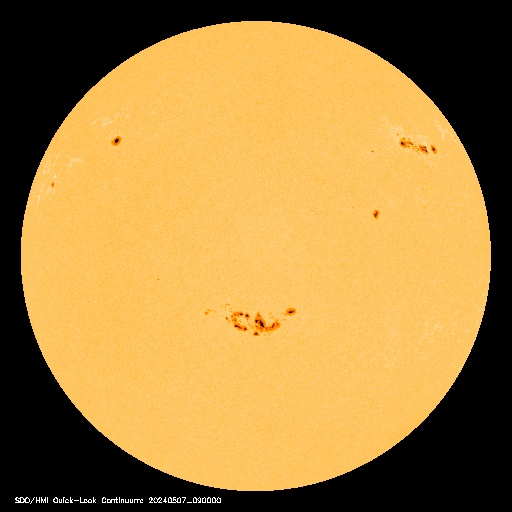
All images of the Sun are made through filters of one kind or another. The least expensive filters are glass or plastic coated with a couple of metallic layers. These greatly reduce the brightness of the Sun, but show it as it would appear to the naked eye if its light were much dimmer. Many of these filters introduce a colour cast to the images, such as the third image above; different brands of filters have different colour casts, but all show essentially the same thing: sunspots and some granulation. William Hershel invented a special prism for viewing the Sun called a Herschel Wedge, which introduces no colour cast. With a Herschel wedge, the Sun appears pure white when close to overhead; only yellow or red when close to the horizon. Baader AstroSolar film is similarly neutral; that's what I use for my white light solar filters.
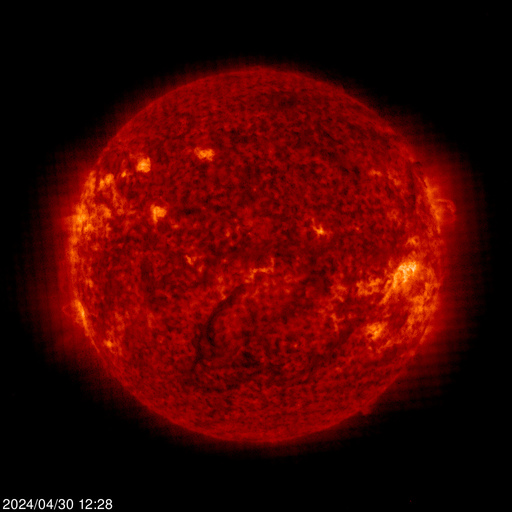
There is a second type of filter which works differently by isolating the wavelength of a single molecule, hydrogen. The hydrogen in the Sun shows a lot more intricate detail than ordinary white light. The first two images you cited were made in hydrogen light, the red alpha line in particular. I own a telescope with a hydrogen alpha filter, and through it the Sun appears a deep rich red. In addition to sunspots, you can see dark filaments on the disk and prominences around the Sun's edge, which used to only be visible during total solar eclipses. You can also see solar flares on the surface of the Sun, which appear as a brighter version of the same deep red. With a hydrogen alpha telescope, the Sun is seen to be an incredibly rich and active place. Even during the solar minimum, I was able to see prominences and flares almost every day. Because of the way film and CCDs react to deep red light, these images usually come out more orange than red.