Martian Jelly Donut Riddle Solved
Researchers have determined the now-infamous Martian rock resembling a jelly doughnut, dubbed Pinnacle Island, is a piece of a larger rock broken and moved by the…
Read the articleResearchers have determined the now-infamous Martian rock resembling a jelly doughnut, dubbed Pinnacle Island, is a piece of a larger rock broken and moved by the…
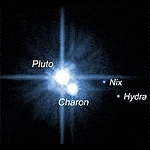
Read the articleWhen NASA’s New Horizons mission was launched, Pluto was still considered one of the nine planets in our solar system. It has since been reclassified as…
Read the articleWith a final, modest, thruster burn yesterday afternoon, ESA’s billion-star surveyor finalised its entry into orbit around ‘L2’, a virtual point far out in space. But…
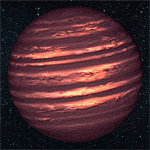
Read the articleSwirling, stormy clouds may be ever-present on cool celestial orbs called brown dwarfs. New observations from NASA’s Spitzer Space Telescope suggest that most brown dwarfs are…
Read the articleMars One is an elaborate marketing event, potential reality show, and a probably-unlikely-to-actually-happen mission to Mars starting in 2018 with an unmanned mission to the planet.…
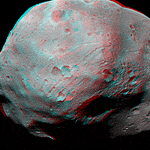
Read the articleThe innermost moon of Mars, Phobos, is seen here in full 360 degree glory. The images were taken by the High Resolution Stereo Camera (HRSC) on…
Read the articleNASA’s Mars Reconnaissance Orbiter has revealed to scientists slender dark markings — possibly due to salty water – that advance seasonally down slopes surprisingly close to…
Read the articleNASA’s Curiosity rover is providing vital insight about Mars’ past and current environments that will aid plans for future robotic and human missions. In a little…
Read the articleA NASA mission that will investigate how Mars lost its atmosphere and abundant liquid water launched into space at 1:28 p.m. EST Monday from Cape Canaveral…
Read the articleThe entry, descent and landing demonstrator module that will fly on the 2016 ExoMars mission has been named ‘Schiaparelli’ in honour of the Italian astronomer Giovanni…
Read the article