
Mars One is an elaborate marketing event, potential reality show, and a probably-unlikely-to-actually-happen mission to Mars starting in 2018 with an unmanned mission to the planet. The plan is to put humans on Mars by 2025. Over 200,000 people applied to be sent on a one-way trip to the Red Planet, and the field has just been narrowed to 1,058 remaining hopefuls. This is probably nothing more that a publicity stunt or a reality TV pitch given the technical hurdles and logistics involved should such a mission actually go ahead.
The 198,942 or so other applicants who were turned down will have a chance to reapply at a later date, but the timeframe for that has not been announced yet.

The Mars Transit Vehicle is a compact space station that will carry the astronauts from Earth orbit to Mars. It is comprised of four parts which are docked in Earth orbit: two propellant stages, a Transit Habitat and a Lander. The propellant stages are used to propel the Transit Vehicle from Earth orbit to Mars. The Transit Habitat is the home for the astronauts during their seven month journey. In it, they sleep, train and prepare for their arrival and landing. When they are near Mars, the astronauts enter the Lander which is then disconnected from the Tranisit Habitat. The Transit habitat and the propellant stages are left behind to orbit the Sun. The Lander is the only component that sets foot on Mars, with the astronauts inside. The Transit habitat has a mass of about 20,000 kg. It will carry close to 800 kg of dry food, 3000 liters of water and 700 kg of oxygen on board. No water or Oxygen will be recycled, because the trip lasts only 210 days. Not recycling these components eliminates the need for recycling systems, backups, spare components and reduces power and cooling requirements. The 3000 liters of water is also used for radiation shielding. – See more at: http://www.mars-one.com/technology/mars-transit-vehicle#sthash.jVBdo4pG.dpuf
As for those that did make it to the next round, the Mars One Chief Medical Officer Dr. Norbert Kraft said in a press release:
The next several selection phases in 2014 and 2015 will include rigorous simulations, many in team settings, with focus on testing the physical and emotional capabilities of our remaining candidates. We expect to begin understanding what is motivating our candidates to take this giant leap for humankind. This is where it really gets exciting for Mars One, our applicants, and the communities they’re a part of.
Exactly what the next few phases will entail is still being worked out as Mars One is pitching itself as a reality television event. This may actually end up being a pseudo-reality TV event, something akin to the faked Mars mission in the 1980s movie Capricorn One, but the novelty factor could make it very watchable.
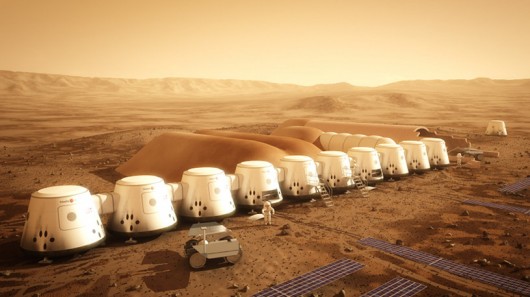
The Life Support Unit is connected to the Living Unit by a tube which feeds the oxygen, nitrogen, and argon to create a habitable atmosphere. Once the astronauts have landed, it will also be in charge of the water purification and removal of waste gas (carbon dioxide) from the Living Unit atmosphere. The Life Support Unit is hosted inside a Lander. This system will be very similar to those units which are fully functional on-board the International Space Station.
Mars One have launched an Indiegogo campaign to pay Lockheed Martin to do an initial study for sending an unmanned lander and satellite from Earth to Mars. They’re trying to raise $400,000 for this initial step. With 26 days to go, they’re at $106,787.
Given that the campaign started on December 10, 2013, and they’ve raised a quarter of what they’re looking for in half the campaign’s lifetime, it doesn’t look like they’ll meet their target. There could always be late donations though that will see the sum raised rise rapidly as the campaign comes to a close.
This first study is a very small step towards an incredibly ambitious plan, but it’s the kind of step Mars One needs to be taking if they want us to take them seriously. However, by crowdfunding this study, they’re putting the onus to solve the bigger problems on contributors rather than trying to solve them themselves.
While this project might be a bit “pie in the sky”, it could become a rallying point for space enthusiasts who are fed up waiting for NASA and others to deliver on the dream of spaceflight that was promised to ordinary people back in the 60s. 40 years stuck in low-Earth orbit has been far too long and, while Mars One may not deliver on its lofty goals, it might boost the idea of human exploration and settlement of another planet in the general human consciousness. It’s long past the time we should left the cradle of Earth. Time to suck it up and actually go and do something about becoming a 2-planet civilization. They way things are going on Earth, we need that second planet!
Have something to add to this story? Share it in the comments.
Filed under: Mars





I’m curious to finhd out what blog platform yyou
are using? I’m experiencing some small security problems with
my latest site and I would like to find something more safeguarded.
Do you have any suggestions?
Hi Chandra,
I use WordPress but all my blogs are security hardened because there are so many hackers out there. Take a look at my http://www.TopDesignBlogs.com site for options on getting a secure blog built.
Regards,
Gary