There is an old chestnut about a pedestrian who once asked a virtuoso violinist near Carnegie Hall how to get to the famed concert venue. The virtuoso’s answer: practice!

This video shows the scientists’ best guess to date of what the surface of the protoplanet Vesta might look like. It was created as part of an exercise for NASA’s Dawn …

Read the rest of this article
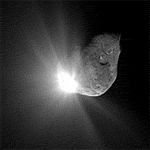
NASA’s Stardust spacecraft returned new images of a comet showing a scar resulting from the 2005 Deep Impact mission. The images also showed the comet has a fragile and weak nucleus.

The spacecraft made its closest approach to comet Tempel 1 on Monday, Feb. 14, at 8:40 p.m. PST (11:40 p.m. EST) at a distance of approximately 178 kilometers (111 …

Read the rest of this article

Mission controllers at NASA’s Jet Propulsion Laboratory, Pasadena, Calif., watched as data downlinked from the Stardust spacecraft indicated it completed its closest approach with comet Tempel 1. An hour after closest approach, the spacecraft turned to point its large, high-gain antenna at Earth. It is expected that images of the comet’s nucleus collected during the flyby will be received on …

Read the rest of this article
Stars at all stages of development, from dusty little tots to young adults, are on display in a new image from NASA’s Spitzer Space Telescope.

This cosmic community is called the North American nebula. In visible light, the region resembles the North American continent, with the most striking resemblance being the Gulf of Mexico. But in Spitzer’s infrared view, the …

Read the rest of this article

Astronomers have discovered a massive cluster of young galaxies forming in the distant universe. The growing galactic metropolis, named COSMOS-AzTEC3, is the most distant known massive “proto-cluster” of galaxies, lying about 12.6 billion light-years away from Earth. Members of the developing cluster are shown here, circled in white, in this image taken by Japan’s Subaru telescope atop Mauna Kea in

Read the rest of this article

Two images of the Phoenix Mars lander taken from Martian orbit in 2008 and 2010. The 2008 lander image shows two relatively blue spots on either side corresponding to the spacecraft’s clean circular solar panels. In the 2010 image scientists see a dark shadow that could be the lander body and eastern solar panel, but no shadow from the western

Read the rest of this article

Sometimes you can’t believe your eyes. This weekend is one of those times.

On Saturday night, June 30th, step outside at sunset and look around. You’ll see a giant moon rising in the east. It looks like Earth’s moon with the usual craters and seas, but something’s wrong. This full moon is strangely inflated. It’s huge!

You’ve just experienced the …

Read the rest of this article