One particular mountain on Mars, bigger than Colorado’s grandest, has been beckoning would-be explorers since it was first sighted from orbit in the 1970s. Scientists have ideas about how it took shape in the middle of ancient Gale Crater and hopes for what evidence it could yield about whether conditions on Mars have favored life.


Curiosity, the big rover of …

Read the rest of this article

NASA’s Dawn spacecraft has revealed unexpected details on the surface of the giant asteroid Vesta. New images and data highlight the diversity of Vesta’s surface and reveal unusual geologic features, some of which were never previously seen on asteroids.


In this image from NASA’s Dawn spacecraft, bright material extends out from the crater Canuleia on Vesta. The bright material appears …

Read the rest of this article

NASA unveiled a new atlas and catalog of the entire infrared sky today showing more than a half billion stars, galaxies and other objects captured by the Wide-field Infrared Survey Explorer (WISE) mission.


This is a mosaic of the images covering the entire sky as observed by the Wide-field Infrared Survey Explorer (WISE), part of its All-Sky Data Release. Image …

Read the rest of this article

The second of NASA’s two Gravity Recovery And Interior Laboratory (GRAIL) spacecraft has successfully completed its planned main engine burn and is now in lunar orbit. Working together, GRAIL-A and GRAIL-B will study the moon as never before.


Artist concept of GRAIL-B performing its lunar orbit insertion burn. Image credit: NASA/JPL-Caltech

“NASA greets the new year with a new mission …

Read the rest of this article

The first of two NASA spacecraft to study the moon in unprecedented detail has entered lunar orbit.

NASA’s Gravity Recovery And Interior Laboratory (GRAIL)-A spacecraft successfully completed its planned main engine burn at 2 p.m. PST (5 p.m. EST) today. As of 3 p.m. PST (6 p.m. EST), GRAIL-A is in an orbit of 56 miles by 5,197 miles (90 …

Read the rest of this article

Vesta appears in a splendid rainbow-colored palette in new images obtained by NASA’s Dawn spacecraft. The colors, assigned by scientists to show different rock or mineral types, reveal Vesta to be a world of many varied, well-separated layers and ingredients. Vesta is unique among asteroids visited by spacecraft to date in having such wide variation, supporting the notion that it …

Read the rest of this article

NASA’s Kepler mission has confirmed its first planet in the “habitable zone,” the region around a star where liquid water could exist on a planet’s surface. Kepler also has discovered more than 1,000 new planet candidates, nearly doubling its previously known count. Ten of these candidates are near-Earth-size and orbit in the habitable zone of their host star. Candidates require …

Read the rest of this article

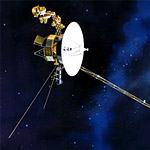
NASA’s Voyager 1 spacecraft has entered a new region between our solar system and interstellar space. Data obtained from Voyager over the last year reveal this new region to be a kind of cosmic purgatory. In it, the wind of charged particles streaming out from our sun has calmed, our solar system’s magnetic field is piled up, and higher-energy particles …

Read the rest of this article

Images from NASA’s Mars Reconnaissance Orbiter (MRO) show sand dunes and ripples moving across the surface of Mars at dozens of locations and shifting up to several yards. These observations reveal the planet’s sandy surface is more dynamic than previously thought.


A dune in the northern polar region of Mars shows significant changes between two images taken on June 25, …

Read the rest of this article

NASA’s Deep Space Network antenna in Goldstone, Calif. has captured new radar images of Asteroid 2005 YU55 passing close to Earth.


This radar image of asteroid 2005 YU55 was obtained on Nov. 7, 2011, at 11:45 a.m. PST (2:45 p.m. EST/1945 UTC), when the space rock was at 3.6 lunar distances, which is about 860,000 miles, or 1.38 million kilometers, …

Read the rest of this article