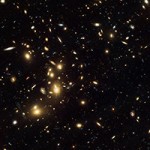
NASA’s Great Observatories are teaming up to look deeper into the universe than ever before. With a boost from natural “zoom lenses” found in space, they should be able to uncover galaxies that are as much as 100 times fainter than what the Hubble, Spitzer, and Chandra space telescopes can typically see.

This ambitious collaborative program is called The Frontier …

Read the rest of this article
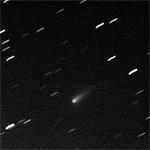
Observations indicate that the sudden exposure to strong sunlight when the currently dark side of the comet gets closer to the Sun could trigger huge outbursts.

Scientists are unraveling more information on Comet ISON (C/2012 S1) as it continues on its journey toward the Sun. ISON will skim 730,000 miles (1.3 million kilometers) above the Sun’s surface November 28 and …

Read the rest of this article
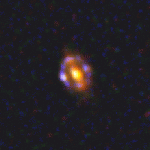
An international team of astronomers has found the most distant gravitational lens yet – a galaxy that, as predicted by Albert Einstein’s general theory of relativity, deflects and intensifies the light of an even more distant object.

The discovery provides a rare opportunity to directly measure the mass of a distant galaxy. The observation also poses a mystery: lenses of …

Read the rest of this article

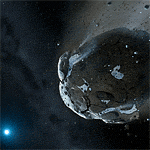
Astronomers using NASA’s Hubble Space Telescope have found the building blocks of solid planets that are capable of having substantial amounts of water. This rocky debris, currently orbiting a white dwarf star called GD 61, is considered a relic of a planetary system that survived the burnout of its parent star. The finding suggests that the star system — located …

Read the rest of this article

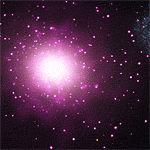
Astronomers using NASA’s Hubble Space Telescope and Chandra X-ray Observatory and telescopes on the ground may have found the most crowded galaxy in our part of the universe.

The ultra-compact dwarf galaxy, known as M60-UCD1, is packed with an extraordinary number of stars and may be the densest galaxy near Earth. It is providing astronomers with clues to its intriguing …

Read the rest of this article

ESA’s space missions are getting ready to observe an icy visitor to the inner Solar System: Comet ISON, which might also be visible in the night sky later this year as a naked eye object.

The comet was discovered in images taken on 21 September 2012 by astronomers Artyom Novichonok and Vitali Nevski using a 40 cm-diameter telescope that is …

Read the rest of this article

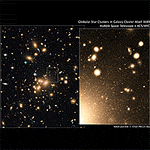
NASA’s Hubble Space Telescope has uncovered the largest known population of globular star clusters, an estimated 160,000, swarming like bees inside the crowded core of the giant grouping of galaxies Abell 1689. By comparison, our Milky Way galaxy hosts about 150 such clusters.

Studying globular clusters is critical to understanding the early, intense star-forming episodes that marked galaxy formation. The …

Read the rest of this article
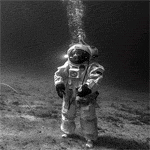
ESA astronaut Jean-François Clervoy and ESA astronaut instructor Hervé Stevenin slipped into the roles of Neil Armstrong and Buzz Aldrin last week for an underwater simulation of the historic mission to the Moon.

Training astronauts underwater is an effective way of getting used to the sensations of working in weightlessness for long periods.


ESA astronaut Jean-François Clervoy collecting a rock …

Read the rest of this article
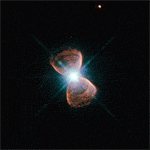
Astronomers have used the NASA/ESA Hubble Space Telescope and ESO’s New Technology Telescope to explore more than 100 planetary nebulae in the central bulge of our galaxy. They have found that butterfly-shaped members of this cosmic family tend to be mysteriously aligned — a surprising result given their different histories and varied properties.

The final stages of life for a …

Read the rest of this article
Thanks to new technology developed in part at the University of Arizona, astronomers can now view objects in the sky at unprecedented sharpness in visible light. Using a telescope mirror that vibrates a thousand times each second to counteract atmospheric flickering, the team has achieved image resolution capabilities that could see a baseball diamond on the moon.

Astronomers at the …

Read the rest of this article