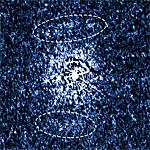
Astronomers using NASA’s Hubble Space Telescope have found compelling evidence of a planet forming 7.5 billion miles away from its star, a finding that may challenge current theories about planet formation.


This graphic shows a gap in a protoplanetary disk of dust and gas whirling around the nearby red dwarf star TW Hydrae. The gap’s presence is best explained as …
Read the rest of this article

A flash of light from a stellar outburst has been used to probe for the first time the 3-D structure of material ejected by an erupting nova.

Astronomers used NASA’s Hubble Space Telescope to observe the light emitted by the close double-star system T Pyxidis, or T Pyx, a recurrent nova, during its latest outburst in April 2011. Contrary to …

Read the rest of this article


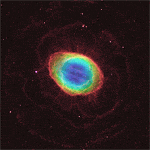
In this composite image, visible-light observations by NASA’s Hubble Space Telescope are combined with infrared data from the ground-based Large Binocular Telescope in Arizona to assemble a dramatic view of the well-known Ring Nebula. Credit: NASA, ESA, C.R. Robert O’Dell (Vanderbilt University), G.J. Ferland (University of Kentucky), W.J. Henney and M. Peimbert (National Autonomous University of Mexico). Credit for Large

Read the rest of this article

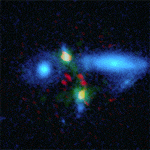
A massive and rare merging of two galaxies has been spotted in images taken by the Herschel space observatory, a European Space Agency mission with important NASA participation.

Follow-up studies by several telescopes on the ground and in space, including NASA’s Hubble Space Telescope and Spitzer Space Telescope, tell a tale of two faraway galaxies intertwined and furiously making stars. …

Read the rest of this article

Bright arcs are smeared around the heart of galaxy cluster Abell S1077 in this image taken by the NASA/ESA Hubble space telescope. The arcs are stretched images of distant galaxies distorted by the cluster’s enormous gravitational field.

Galaxy clusters are large groupings of galaxies, each hosting millions of stars. They are the largest existing structures in the Universe, bound by …

Read the rest of this article

NASA’s Hubble Space Telescope has found the building blocks for Earth-sized planets in an unlikely place– the atmospheres of a pair of burned-out stars called white dwarfs.

These dead stars are located 150 light-years from Earth in a relatively young star cluster, Hyades, in the constellation Taurus. The star cluster is only 625 million years old. The white dwarfs are …

Read the rest of this article

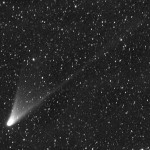
Later this year, Comet ISON is expected to become a naked-eye object when it skims through the atmosphere of the sun. The Hubble Space Telescope has just obtained a sneak preview.

Hubble photographed ISON on April 10th. At the time, the comet was 386 million miles from the sun (394 million miles from Earth), just inside the orbit of Jupiter. …

Read the rest of this article

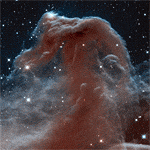
New views of the Horsehead Nebula and its turbulent environment have been unveiled by ESA’s Herschel space observatory and the NASA/ESA Hubble space telescope.


Stunning new view from ESA’s Herschel space observatory of the iconic Horsehead Nebula in the context of its surroundings. The image is a composite of the wavelengths of 70 microns (blue), 160 microns (green) and 250 …

Read the rest of this article

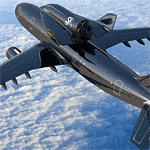
In the wake of the Space Shuttle’s demise, new spacecraft are being developed in droves. While all existing craft are space capsules, not unlike those used back in the Apollo era, several of the next generation of spacecraft may be spaceplanes. One contender is being built in Switzerland, with the first prototype to be completed next year.

The SOAR spaceplane …

Read the rest of this article

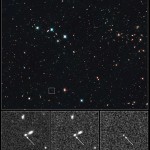
NASA’s Hubble Space Telescope has found the farthest supernova so far of the type used to measure cosmic distances. Supernova UDS10Wil, nicknamed SN Wilson after American President Woodrow Wilson, exploded more than 10 billion years ago.


This is a Hubble Space Telescope view looking long ago and far away at a supernova that exploded over 10 billion years ago. The …

Read the rest of this article