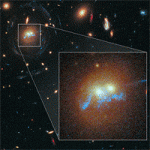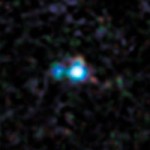
Astronomers using NASA’s Hubble Space Telescope for the first time have spotted a star system that later produced an unusual supernova explosion of a white dwarf, the stripped-down core of an ordinary star at the end of its life.

Examining archived Hubble images taken before the supernova, astronomers say they have detected the blue companion star of the white dwarf. …

Read the rest of this article
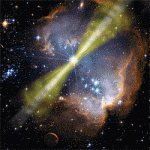
ESA’s XMM-Newton observatory has helped to uncover how the Universe’s first stars ended their lives in giant explosions.

Astronomers studied the gamma-ray burst GRB130925A – a flash of very energetic radiation streaming from a star in a distant galaxy – using space- and ground-based observatories.

They found the culprit producing the burst to be a massive star, known as a …

Read the rest of this article

Astronomers routinely use the crisp view of NASA’s Hubble Space Telescope to study all kinds of intricate details in galaxy clusters. By now you would think they’ve seen it all — but nature always has new surprises in store.

The latest is an uncanny 100,000-light-year-long structure that looks like a string of pearls twisted into a corkscrew shape that winds …

Read the rest of this article

Hubble Space Telescope

They may be little, but they pack a big star-forming punch. New observations from NASA’s Hubble Space Telescope show small galaxies, also known as dwarf galaxies, are responsible for forming a large proportion of the universe’s stars.

Studying this early epoch of the universe’s history is critical to fully understanding how these stars formed and how galaxies grew and evolved …

Read the rest of this article

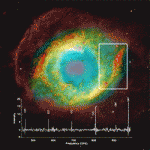
Using ESA’s Herschel space observatory, astronomers have discovered that a molecule vital for creating water exists in the burning embers of dying Sun-like stars.

When low- to middleweight stars like our Sun approach the end of their lives, they eventually become dense, white dwarf stars. In doing so, they cast off their outer layers of dust and gas into space, …

Read the rest of this article

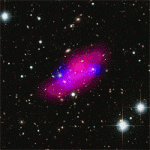
Galaxies are not as isolated as they at first glance may seem; on a cosmic scale they congregate in clumps along with dark matter and hot gas. The colourful blob in this new composite image, based on data from several telescopes including ESA’s XMM-Newton, is the group of galaxies known as the Bullet Group. Its components appear to be clearly …

Read the rest of this article

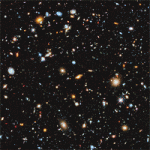
Astronomers using the Hubble Space Telescope have captured the most comprehensive picture ever assembled of the evolving Universe – and one of the most colourful. The study is called the Ultraviolet Coverage of the Hubble Ultra Deep Field (UVUDF) project.

Prior to this survey, astronomers were in a curious position. They knew a lot about star formation occurring in nearby …

Read the rest of this article

Jupiter’s trademark Great Red Spot — a swirling anti-cyclonic storm larger than Earth — has shrunk to its smallest size ever measured.

According to Amy Simon of NASA’s Goddard Space Flight Center in Greenbelt, Maryland, recent NASA Hubble Space Telescope observations confirm the Great Red Spot   now is approximately 10,250 miles across. Astronomers have followed this downsizing since the 1930s.…

Read the rest of this article

AAVSO AAVSO Alert Notice 501
Predicted occultation of Regulus
April 30, 2014

Dr. Peter Garnavich (University of Notre Dame) and Dr. Paula Szkody (University of Washington) have requested the help of AAVSO observers in monitoring the cataclysmic variable SBS 1108+574 (= CSS 120422:111127+571239) in support of upcoming Hubble Space Telescope observations. The HST COS (Cosmic Origins Spectrograph) will be carrying out …

Read the rest of this article

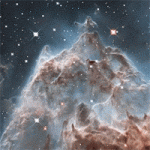
The Monkey Head Nebula (also known as NGC 2174) is a star-forming region in which bright, newborn stars near the center of the nebula illuminate the surrounding gas with energetic radiation. This radiation, along with strong stellar winds, erodes away the lower density gas. Pockets of higher density gas resist this erosion, and form pillars and peaks along the inner …

Read the rest of this article