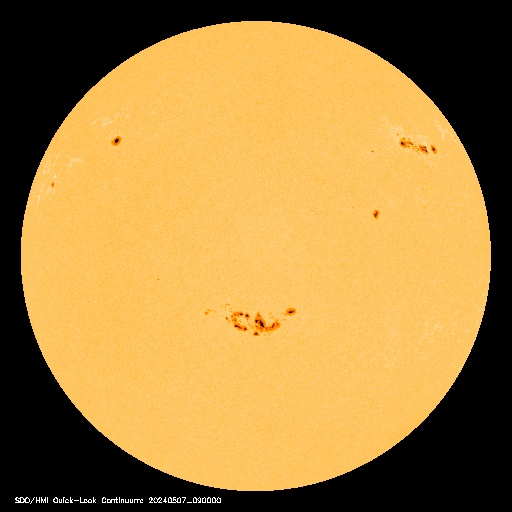
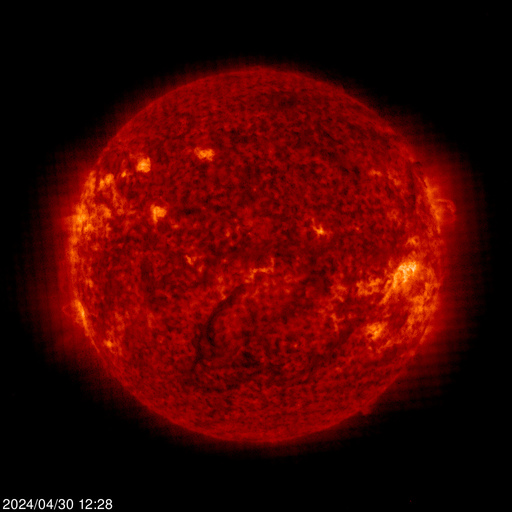
Glowing green and red, shimmering hypnotically across the night sky, the aurora borealis is a wonder to behold. Longtime sky watchers say it is the greatest show on Earth.

It might be the greatest show in Earth orbit, too. High above our planet, astronauts onboard the International Space Station (ISS) have been enjoying an up-close view of auroras outside their …

Read the rest of this article
Big sunspot AR1429, which emerged over the weekend, is crackling with strong flares.

This morning the active region produced an X1-class eruption and a bright coronal mass ejection (CME). This is the strongest so far, occuring on March 5th at 0413 UT.

The CME appears set to deliver a glancing blow to Earth’s magnetic field in the days ahead, possibly …

Read the rest of this article
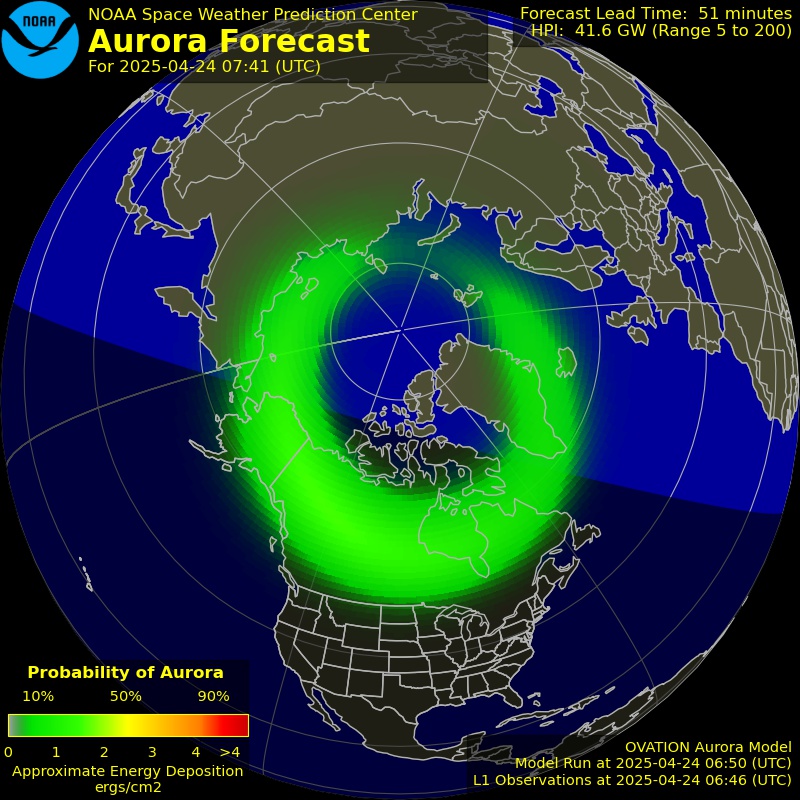
Earth’s magnetic field reverberated from a Coronal Mass Ejection (CME) impact during the early hours of Jan. 22nd. The hit compressed Earth’s magnetic field, briefly exposing some geosynchronous satellites to solar wind plasma, and disturbed the ionization structure of Earth’s upper atmosphere.

As night fell on Jan. 22nd, Arctic sky watchers reported bright auroras in response to a polar geomagnetic …

Read the rest of this article
Active sunspot 1401 erupted yesterday, Jan. 19th, for more than an hour around 16:00 UT.

The long-duration blast produced an M3-class solar flare and a Coronal Mass Ejection that appears to be heading toward Earth.

Forecasters say strong geomagnetic storms are possible when the cloud arrives during the late hours of Jan. 21st. High-latitude (and possibly middle-latitude) sky watchers should …

Read the rest of this article

For the third day in a row, sunspot 1261 has unleashed a significant M-class solar flare. The latest blast at 0357 UT on August 4th registered M9.3 on the Richter Scale of Flares, almost crossing the threshold into X-territory (X-flares are the most powerful kind).

Earth’s magnetic field is likely to receive a double-strike from the clouds of gas on …

Read the rest of this article

On August 2nd, the sun hurled a cloud of plasma (Coronal Mass Ejection – CME) toward Earth when magnetic fields above sunspot 1261 erupted. Analysts expect the CME to arrive during the early hours of August 5th, possibly sparking geomagnetic storms around the poles.

This is not a big event; the eruption that propelled the cloud in our direction registered …

Read the rest of this article

June 24: NASA’s next Mars rover has completed the journey from its California birthplace to Florida in preparation for launch this fall. The Mars Science Laboratory rover, also known as Curiosity, arrived late Wednesday night at NASA’s Kennedy Space Center aboard an Air Force C-17 transport plane.

June 24: NASA’s Cassini spacecraft has discovered the best evidence

Read the rest of this article

The first day of northern summer began with a solar flare. Magnetic fields above sunspot complex 1236 erupted during the early hours of June 21st, hurling a coronal mass ejection (CME) almost directly toward Earth. The incoming CME does not appear to be particularly potent; nevertheless, the cloud could trigger polar geomagnetic storms when it reaches Earth on or about …

Read the rest of this article

A pair of NASA spacecraft that were supposed to be dead a year ago are instead flying to the Moon for a breakthrough mission in lunar orbit.

“Their real names are THEMIS P1 and P2, but I call them ‘dead spacecraft walking,'” says Vassilis Angelopoulos of UCLA, principal investigator of the THEMIS mission. “Not so long ago, we thought they …

Read the rest of this article

Strange Space Weather

Something strange is happening in the atmosphere above Africa and researchers have converged on Addis Ababa, Ethiopia, to discuss the phenomenon. The Africa Space Weather Workshop kicked off Nov. 12th with nearly 100 scientists and students in attendance.

The strange phenomenon that brings all these people together is the ion plume—"a newly discovered form of space weather," says University of …

Read the rest of this article