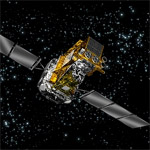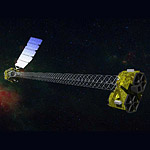
NASA’s Nuclear Spectroscopic Telescope Array (NuSTAR) launched into the morning skies over the central Pacific Ocean at noon EDT (9 a.m. PDT) Wednesday, beginning its mission to unveil secrets of buried black holes and other exotic objects.


NuSTAR has a 30-foot mast that deploys after launch to separate the optics modules (right) from the detectors in the focal plane (left). …
Read the rest of this article

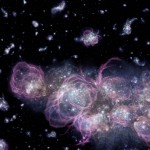
The faint, lumpy glow given off by the very first objects in the universe may have been detected with the best precision yet, using NASA’s Spitzer Space Telescope. These faint objects might be wildly massive stars or voracious black holes. They are too far away to be seen individually, but Spitzer has captured new, convincing evidence of what appears to …

Read the rest of this article

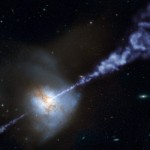
Astronomers have found strong evidence that a massive black hole is being ejected from its host galaxy at a speed of several million miles per hour. New observations from NASA’s Chandra X-ray Observatory suggest that the black hole collided and merged with another black hole and received a powerful recoil kick from gravitational wave radiation.


The galaxy at the center …

Read the rest of this article

Students from across Europe have been selected as the winners of the ESA’s ‘Explore the high-energy Universe’ competition.

Secondary school students were invited to choose from four projects relating to ESA’s Integral gamma-ray observatory in which they were challenged to Observe, Research, Design, or Build.


ESA’s Integral gamma-ray observatory is able to detect gamma-ray bursts, the most energetic phenomena in …

Read the rest of this article

NASA’s Nuclear Spectroscopic Telescope Array, or NuSTAR, is being prepared for the final journey to its launch pad on Kwajalein Atoll in the central Pacific Ocean. The mission will study everything from massive black holes to our own sun. It is scheduled to launch no earlier than June 13.


NASA’s Nuclear Spectroscopic Telescope Array, or NuSTAR, has a complex set …

Read the rest of this article

The Herschel Space Observatory has shown galaxies with the most powerful, active black holes at their cores produce fewer stars than galaxies with less active black holes. The results are the first to demonstrate black holes suppressed galactic star formation when the universe was less than half its current age.


This artistically modified image of the local galaxy Arp 220, …

Read the rest of this article

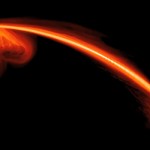
Astronomers have gathered the most direct evidence yet of a supermassive black hole shredding a star that wandered too close. NASA’s Galaxy Evolution Explorer, a space-based observatory, and the Pan-STARRS1 telescope on the summit of Haleakala in Hawaii were among the first to help identify the stellar remains.


This computer-simulated image shows gas from a tidally shredded star falling into …

Read the rest of this article

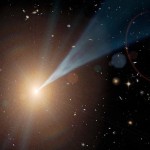
Astronomers are actively hunting a class of supermassive black holes throughout the universe called blazars thanks to data collected by NASA’s Wide-field Infrared Survey Explorer (WISE). The mission has revealed more than 200 blazars and has the potential to find thousands more.


This artist’s concept shows a “feeding,” or active, supermassive black hole with a jet streaming outward at nearly …

Read the rest of this article

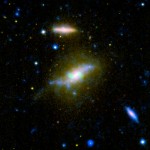
Supernova explosions and the jets of a monstrous black hole are scattering a galaxy’s star-making gas like a cosmic leaf blower, a new study finds. The findings, which relied on ultraviolet observations from NASA’s Galaxy Evolution Explorer and a host of other instruments, fill an important gap in the current understanding of galactic evolution.


Time is running out for the …

Read the rest of this article

The human eye is crucial to astronomy. Without the ability to see, the luminous universe of stars, planets and galaxies would be closed to us, unknown forever. Nevertheless, astronomers cannot shake their fascination with the invisible.

Outside the realm of human vision is an entire electromagnetic spectrum of wonders. Each type of light–­from radio waves to gamma-rays–reveals something unique about …

Read the rest of this article