The Herschel observatory, a European space telescope for which NASA helped build instruments and process data, has stopped making observations after running out of liquid coolant as expected.

The European Space Agency mission, launched almost four years ago, revealed the universe’s “coolest” secrets by observing the frigid side of planet, star and galaxy formation.

“Herschel gave us the opportunity to …

Read the rest of this article
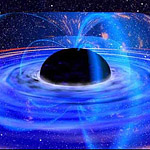
Astronomers have watched as a black hole woke up from a decades-long slumber to feed on a low-mass object – either a brown dwarf or a giant planet – that strayed too close. A similar feeding event, albeit on a gas cloud, will soon happen at the black hole at the centre of our own Milky Way Galaxy.

Loading…


jwplayer("pi_player").setup({ …

Read the rest of this article

Black Hole

Two X-ray space observatories, NASA’s Nuclear Spectroscopic Telescope Array (NuSTAR) and the European Space Agency’s XMM-Newton, have teamed up to measure definitively, for the first time, the spin rate of a black hole with a mass 2 million times that of our sun.


This artist’s concept illustrates a supermassive black hole with millions to billions times the mass of our …

Read the rest of this article

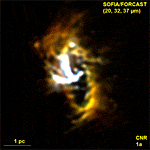
Researchers using the Stratospheric Observatory for Infrared Astronomy (SOFIA) have captured new images of a ring of gas and dust seven light-years in diameter surrounding the supermassive black hole at the center of the Milky Way, and of a neighboring cluster of extremely luminous young stars embedded in dust cocoons.


SOFIA/FORCAST mid-infrared image of the Milky Way galaxy’s nucleus showing …

Read the rest of this article


This new view of spiral galaxy IC 342, also known as Caldwell 5, includes data from NASA’s Nuclear Spectroscopic Telescope Array, or NuSTAR. High-energy X-ray data from NuSTAR have been translated to the color magenta, and superimposed on a visible-light view highlighting the galaxy and its star-studded arms. NuSTAR is the first orbiting telescope to take focused pictures of the …

Read the rest of this article
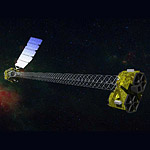
NASA’s newest set of X-ray eyes in the sky, the Nuclear Spectroscopic Telescope Array (NuSTAR), has caught its first look at the giant black hole parked at the center of our galaxy. The observations show the typically mild-mannered black hole during the middle of a flare-up.


NASA’s Nuclear Spectroscopic Telescope Array, or NuSTAR, has captured these first, focused views of …

Read the rest of this article
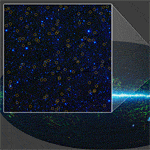
NASA’s Wide-field Infrared Survey Explorer (WISE) mission has led to a bonanza of newfound supermassive black holes and extreme galaxies called hot DOGs, or dust-obscured galaxies.


With its all-sky infrared survey, NASA’s Wide-field Infrared Survey Explorer, or WISE, has identified millions of quasar candidates. Quasars are supermassive black holes with masses millions to billions times greater than our sun. The …

Read the rest of this article
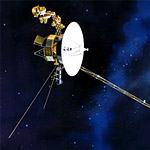
For nearly 35 years, NASA’s Voyager 1 probe has been hurtling toward the edge of the solar system, flying through the dark void on a mission unlike anything attempted before. One day, mission controllers hope, Voyager 1 will leave the solar system behind and enter the realm of the stars—interstellar space.

That day may be upon us.


At the edge …

Read the rest of this article
Black holes in the early universe needed a few snacks rather than one giant meal to fuel their quasars and help them grow, according to observations from NASA’s Spitzer and Hubble space telescopes.


The galaxies pictured here have so much dust surrounding them that the brilliant light from their quasars cannot be seen in these images NASA’s Hubble Space Telescope. …

Read the rest of this article

New evidence from NASA’s Chandra X-ray Observatory challenges prevailing ideas about how black holes grow in the centers of galaxies. Astronomers long have thought that a supermassive black hole and the bulge of stars at the center of its host galaxy grow at the same rate — the bigger the bulge, the bigger the black hole. However, a new study …

Read the rest of this article