 Pluto is the second-largest known dwarf planet in the Solar System (after Eris) and the tenth-largest body observed directly orbiting the Sun. Originally classified as a planet, Pluto is now considered the largest member of a distinct region called the Kuiper belt.
In Roman mythology, Pluto (Greek: Hades) is the god of the underworld. The planet received this name (after many other suggestions) perhaps because it’s so far from the Sun that it is in perpetual darkness and perhaps because “PL” are the initials of Percival Lowell.
Pluto was discovered in 1930 by a fortunate accident. Calculations which later turned out to be in error had predicted a planet beyond Neptune, based on the motions of Uranus and Neptune. Not knowing of the error, Clyde W. Tombaugh at Lowell Observatory in Arizona did a very careful sky survey which turned up Pluto anyway.
After the discovery, it was quickly determined that Pluto was too small to account for the discrepancies in the orbits of the other planets. The search for Planet X continued but nothing was found. Nor is it likely that it ever will be: the discrepancies vanish if the mass of Neptune determined from the Voyager 2 encounter with Neptune is used. There is no Planet X. But that doesn’t mean there aren’t other objects out there, only that there isn’t a relatively large and close one like Planet X was assumed to be. In fact, we now know that there are a very large number of small objects in the Kuiper Belt beyond the orbit of Neptune, some roughly the same size as Pluto.
Like other members of the Kuiper belt, Pluto is composed primarily of rock and ice and is relatively small: approximately a fifth the mass of the Earth’s moon and a third its volume. It has a highly eccentric and highly inclined orbit.
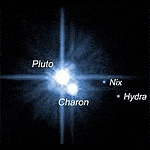
Pluto’s eccentricity takes it from 30 to 49 AU (4.4–7.4 billion km) from the Sun, causing Pluto to occasionally come closer to the Sun than Neptune. Pluto and its largest moon, Charon, are often treated together as a binary system because the barycentre of their orbits does not lie within either body. The International Astronomical Union (IAU) has yet to formalise a definition for binary dwarf planets, and until it passes such a ruling, Charon is classified as a moon of Pluto. Pluto has two known smaller moons, Nix and Hydra, discovered in 2005.
From its discovery in 1930 until 2006, Pluto was counted as the Solar System’s ninth planet. In the late 20th and early 21st centuries, however, many objects similar to Pluto were discovered in the outer solar system, notably the scattered disc object Eris, which is 27% more massive than Pluto. On August 24, 2006 the IAU defined the term “planet” for the first time. This definition excluded Pluto, which the IAU reclassified as a member of the new category of dwarf planets along with Eris and Ceres. After the reclassification, Pluto was added to the list of minor planets and given the number 134340.
| Pluto Links & Resources | ||||||||
|
||||||||
| Meteorite eBooks & Articles | |||||
|
|||||
[phpbay](planet pluto|kuiper mission), 100, “”, “”[/phpbay]
[phpbay]””, 100, “74927”, “”[/phpbay]
[phpbay]””, 100, “74922”, “”[/phpbay]
Planet Pluto Videos:
[tubepress mode=”tag” tagValue=”planet pluto astronomy”]
Amazon.com BestSellers
| [phpzon keywords=”planet pluto” searchindex=”Books” num=”3″] |


Here are some additional interesting facts regarding Pluto:Pluto may share many characteristics with other objects in the Kuiper Belt, but it is also fundamentally different from those objects in one crucial way. Pluto IS a planet because unlike most objects in the Kuiper Belt, it has attained hydrostatic equilibrium, meaning it has enough self-gravity to have pulled itself into a round shape. When an object is large enough for this to happen, it becomes differentiated with core, mantle, and crust, just like Earth and the larger planets, and develops the same geological processes as the larger planets, processes that inert asteroids and most KBOs do not have.Not distinguishing between shapeless asteroids and objects whose composition clearly makes them planets is a disservice and is sloppy science. As of now, there are three other KBOs that meet this criterion and therefore should be classified as planets—Haumea, Makemake, and Eris. Only one KBO has been found to be larger than Pluto, and that is Eris.Only four percent of the International Astronomical Union, most of whom are not planetary scientists, adopted the definition that demoted Pluto–in a process that violated the group’s own bylaws. Their decision was immediately opposed by a petition of 300 professional astronomers saying they will not use the new definition, which they described accurately as “sloppy.†Also significant is the fact that many planetary scientists are not IAU members and therefore had no say in this matter at all.Many believe we should keep the term planet broad to encompass any non-self-luminous spheroidal object orbiting a star. We can distinguish different types of planets with subcategories such as terrestrial planets, gas giants, ice giants, dwarf planets, super Earths, hot Jupiters, etc.We should be broadening, not narrowing our concept of planet as more objects are being discovered in this and other solar systems.The term “plutoids†was adopted by an even smaller group of the IAU and is universally disliked, making it very likely to fall into obscurity.Pluto is a planet!