Earth Day 2015

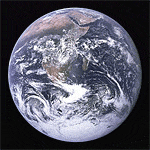
Data from a NASA airborne science mission has revealed an immense and previously unknown canyon hidden under a mile of Greenland ice.

“One might assume that the landscape of the Earth has been fully explored and mapped,” said Jonathan Bamber, professor of physical geography at the University of Bristol in the United Kingdom, and lead author of the study published …

Read the rest of this article

AAVSO AAVSO Alert Notice 490
Optical monitoring of T Ori requested
August 30, 2013

Dr. William Herbst (Wesleyan University) and Rachel Pedersen (Bates College) have requested AAVSO assistance in monitoring the Orion variable T Ori in support of spectroscopy they will be obtaining during September 2013. AAVSO nightly coverage (visual or electronic, not time series) of this star is crucial throughout …

Read the rest of this article

Chandra X-Ray Observatory

Astronomers using NASA’s Chandra X-ray Observatory have taken a major step in explaining why material around the giant black hole at the center of the Milky Way Galaxy is extraordinarily faint in X-rays. This discovery holds important implications for understanding black holes.

New Chandra images of Sagittarius A* (Sgr A*), which is located about 26,000 light-years from Earth, indicate that …

Read the rest of this article

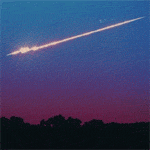
Two nights ago, a ~100 lb meteoroid traveling 53,000 mph hit the atmosphere over the southeastern USA and exploded around 2:30 AM on August 28th, producing sonic booms and a fireball as bright as a full Moon. Researchers are now scouring the countryside for fragments that could reveal the nature and origin of the meteoroid.

NASA’s Meteoroid Environment Office has …

Read the rest of this article

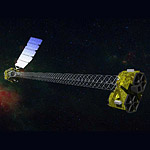
NASA’s Nuclear Spectroscopic Telescope Array, or NuSTAR, is giving the wider astronomical community a first look at its unique X-ray images of the cosmos. The first batch of data from the black-hole hunting telescope is publicly available today, Aug. 29, via NASA’s High Energy Astrophysics Science Archive Research Center, or HEASARC.

“We are pleased to present the world with NuSTAR’s …

Read the rest of this article

Around the world, astronomers are buzzing with anticipation over the approach of Comet ISON. On Thanksgiving Day 2013, the icy visitor from the outer solar system will skim the sun’s outer atmosphere and, if it survives, could emerge as one of the brightest comets in years.

First, though, it has to fly by Mars.

“Comet ISON is paying a visit …

Read the rest of this article

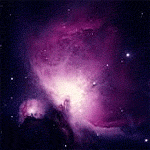
This new view of the Orion A star-formation cloud from ESA’s Herschel space observatory shows the turbulent region of space that hugs the famous Orion Nebula.

The nebula lies about 1500 light years from Earth within the ‘sword of Orion’ – below the three main stars that form the belt of the Orion constellation.

In this view, the nebula corresponds …

Read the rest of this article

Thanks to new technology developed in part at the University of Arizona, astronomers can now view objects in the sky at unprecedented sharpness in visible light. Using a telescope mirror that vibrates a thousand times each second to counteract atmospheric flickering, the team has achieved image resolution capabilities that could see a baseball diamond on the moon.

Astronomers at the …

Read the rest of this article

Spaceport News is a biweekly NASA publication that serves Kennedy Space Center civil service and contractor employees. The publication covers a variety of topics, primarily related to Kennedy’s business of processing, launching and landing spacecraft and payloads for Earth orbit and deep space.

In this issue: an optical communications technology demonstration experiment, a test of the prototype spacecraft called Dream …

Read the rest of this article

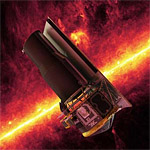
Ten years after a Delta II rocket launched NASA’s Spitzer Space Telescope, lighting up the night sky over Cape Canaveral, Fla., the fourth of the agency’s four Great Observatories continues to illuminate the dark side of the cosmos with its infrared eyes.

The telescope studied comets and asteroids, counted stars, scrutinized planets and galaxies, and discovered soccer-ball-shaped carbon spheres in …

Read the rest of this article