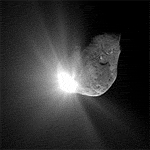
NASA’s Deep Impact Mission Has Ended
After almost 9 years in space that included an unprecedented July 4th impact and subsequent flyby of a comet, an additional comet flyby, and the return…
Read the articleAfter almost 9 years in space that included an unprecedented July 4th impact and subsequent flyby of a comet, an additional comet flyby, and the return…
Read the articleNASA is seeking applications from U.S. graduate students for the agency’s Space Technology Research Fellowships. The research grants, worth as much as $68,000 per year, will…
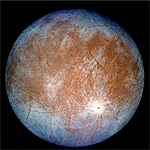
Read the articleBy analyzing the distinctive cracks lining the icy face of Europa, NASA scientists found evidence that this moon of Jupiter likely spun around a tilted axis…
Read the articleLike a dragon breathing fire, a powerful blast of plasma erupts from the Sun in this colourised view of a ‘coronal mass ejection’. These huge clouds…
Read the articleComets and other icy celestial bodies have some basic building blocks for life, but it takes violent impacts to take them to the next level, according…
Read the articleThe Harvest Moon is the full Moon that falls closest to the autumnal equinox, the beginning of northern autumn. In 2013 the Moon is full on…
Read the articleThe moon holds a significant relationship with the Earth: if there were no moon, our daily lives as humans would significantly change. The first and most…
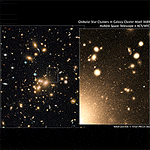
Read the articleNASA’s Hubble Space Telescope has uncovered the largest known population of globular star clusters, an estimated 160,000, swarming like bees inside the crowded core of the…
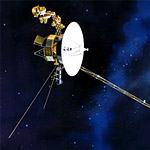
Read the articleNASA’s Voyager 1 spacecraft officially is the first human-made object to venture into interstellar space. The 36-year-old probe is about 12 billion miles (19 billion kilometers)…
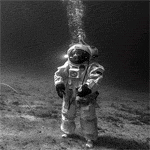
Read the articleESA astronaut Jean-François Clervoy and ESA astronaut instructor Hervé Stevenin slipped into the roles of Neil Armstrong and Buzz Aldrin last week for an underwater simulation…
Read the article