Astronomers using data from NASA’s Kepler and Spitzer space telescopes have created the first cloud map of a planet beyond our solar system, a sizzling, Jupiter-like world known as Kepler-7b.

The planet is marked by high clouds in the west and clear skies in the east. Previous studies from Spitzer have resulted in temperature maps of planets orbiting other stars, …

Read the rest of this article

On Sept. 29th, a long filament of magnetism in the sun’s northern hemisphere erupted, producing a magnificent CME and the must-see movie above from NASA’s Solar Dynamics Observatory. Although the CME was not aimed at Earth, our planet might receive a glancing blow from the cloud on Oct. 2-3.

This event also hurled a magnificent CME into space. The magnetized …

Read the rest of this article

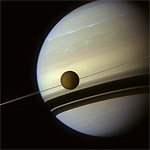
Saturn and Titan

NASA’s Cassini spacecraft has detected propylene, a chemical used to make food-storage containers, car bumpers and other consumer products, on Saturn’s moon Titan.

This is the first definitive detection of the plastic ingredient on any moon or planet, other than Earth.

A small amount of propylene was identified in Titan’s lower atmosphere by Cassini’s Composite Infrared Spectrometer (CIRS). This instrument …

Read the rest of this article

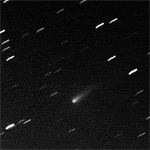
The countdown clock is ticking to comet ISON’s hair-raising passage around the sun on Nov. 28, as it grazes the sun at a distance of only 1.5 times the sun’s radius. Astronomers continue reworking estimates of how much of an impression the far visitor will make to Earthbound observers.

The prognostication is so chancy that I couldn’t even get comet-hunting …

Read the rest of this article

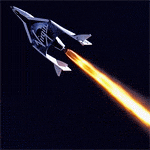
In an interview earlier this week, Virgin boss Richard Branson hinted that he has “another idea” for cheaper space travel.

“The next ten years will be quite expensive (for space tourism) … that will enable us to bring the price down quite considerably over the years to come,” said Branson while being interviewed by Business Insider in New York promoting …

Read the rest of this article

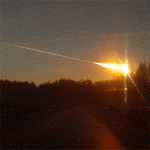
Just before midnight on Sept. 27-28, sky watchers in more than a dozen US states witnessed a bright flash of light. NASA all-sky cameras recorded a brilliant fireball, which analysts believe was a meter-class space rock exploding almost directly above Columbus, Ohio.

Witnesses reported shadows cast upon the ground, unusual sounds, and a swirling contrail marking the aftermath of the …

Read the rest of this article

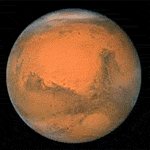
The Planet Mars

NASA’s Curiosity rover is revealing a great deal about Mars, from long-ago processes in its interior to the current interaction between the Martian surface and atmosphere.

Examination of loose rocks, sand and dust has provided new understanding of the local and global processes on Mars. Analysis of observations and measurements by the rover’s science instruments during the first four months …

Read the rest of this article

Astronomers using NASA’s Hubble Space Telescope and Chandra X-ray Observatory and telescopes on the ground may have found the most crowded galaxy in our part of the universe.

The ultra-compact dwarf galaxy, known as M60-UCD1, is packed with an extraordinary number of stars and may be the densest galaxy near Earth. It is providing astronomers with clues to its intriguing …

Read the rest of this article

A useful point of comparison is Comet Lovejoy, which put on a grand show after it brushed the sun in 2011. People in the southern hemisphere still remember the comet’s tail stretching halfway across the night sky. Judging from the brightness of Comet ISON, Matthew Knight of the Lowell Observatory believes that “ISON is likely a few times bigger than …

Read the rest of this article

ESA’s space missions are getting ready to observe an icy visitor to the inner Solar System: Comet ISON, which might also be visible in the night sky later this year as a naked eye object.

The comet was discovered in images taken on 21 September 2012 by astronomers Artyom Novichonok and Vitali Nevski using a 40 cm-diameter telescope that is …

Read the rest of this article