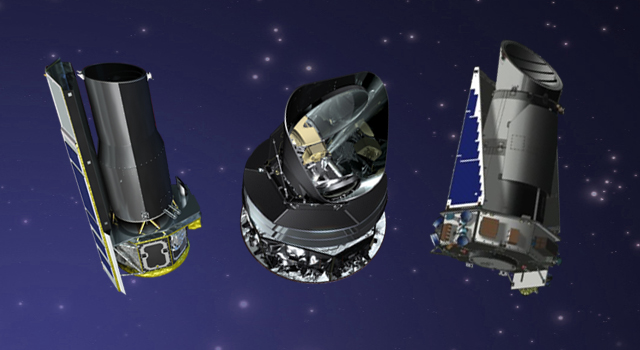
NASA’s Great Observatories Teaming Up for Deepest Look Into the Universe
NASA’s Great Observatories are teaming up to look deeper into the universe than ever before. With a boost from natural “zoom lenses” found in space, they…
Read the articleNASA’s Great Observatories are teaming up to look deeper into the universe than ever before. With a boost from natural “zoom lenses” found in space, they…
Read the articleOn Oct. 22, 1968, Apollo 7 splashed down in the Atlantic Ocean after 11 days in space. Though often overlooked, Apollo 7 was a significant mission.…
Read the articleWith the sun now shining down over the north pole of Saturn’s moon Titan, a little luck with the weather, and trajectories that put the spacecraft…
Read the articleESA’s Planck space telescope has been turned off after nearly 4.5 years soaking up the relic radiation from the Big Bang and studying the evolution of…
Read the articleFor NASA and its dozens of missions, data pour in every day like rushing rivers. Spacecraft monitor everything from our home planet to faraway galaxies, beaming…
Read the articleObservations indicate that the sudden exposure to strong sunlight when the currently dark side of the comet gets closer to the Sun could trigger huge outbursts.…
Read the articleFrom the tiniest fraction of a second after the Big Bang to the evolution of stars and galaxies over 13.8 billion years, ESA’s Planck space telescope…
Read the articleIf you’re just starting out on your journey across the celestial sphere, the Levenhuk Strike 90 PLUS telescope will be the perfect instrument for you. It…
Read the articleAn international team of astronomers has found the most distant gravitational lens yet – a galaxy that, as predicted by Albert Einstein’s general theory of relativity,…
Read the articleWe now have the technology to go snooping for extraterrestrials in our own backyard. No, not as close as little green men cutting up crop circles;…
Read the article