Anyone who has flown long distances will be familiar with the jetlag that comes with travelling across time zones. Our body clocks need time to adjust to different daylight times as high-fliers and frequent travellers know all too well. But what about astronauts, the highest fliers of all? Do they suffer from rocket-lag?


ESA astronaut Paolo Nespoli in his sleeping …

Read the rest of this article

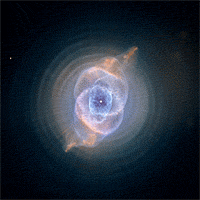
Three thousand light years from Earth, the Cat’s Eye Nebula (NGC 6543) is a sight that draws in the human eye. In this image from the NASA/ESA Hubble Space Telescope, numerous bubbles are visible – shapes generated by the ejection of glowing gas as the star at its centre approaches the end of its life.

While large stars die in …

Read the rest of this article

Exoplanets

Weather forecasters on exoplanet GJ 1214b would have an easy job. Today’s forecast: cloudy. Tomorrow: overcast. Extended outlook: more clouds.

Two teams of scientists using NASA’s Hubble Space Telescope report they have characterized the atmospheres of a pair of planets with masses intermediate between gas giants, like Jupiter, and smaller, rockier planets, like Earth. A survey by NASA’s Kepler space …

Read the rest of this article

Mars One is an elaborate marketing event, potential reality show, and a probably-unlikely-to-actually-happen mission to Mars starting in 2018 with an unmanned mission to the planet. The plan is to put humans on Mars by 2025. Over 200,000 people applied to be sent on a one-way trip to the Red Planet, and the field has just been narrowed to 1,058 …

Read the rest of this article

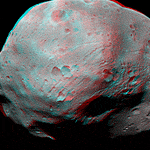
The innermost moon of Mars, Phobos, is seen here in full 360 degree glory. The images were taken by the High Resolution Stereo Camera (HRSC) on ESA’s Mars Express at various times throughout the mission’s 10 years.

The moon’s parallel sets of grooves are perhaps the most striking feature, along with the giant 9 km-wide Stickney impact crater that dominates …

Read the rest of this article

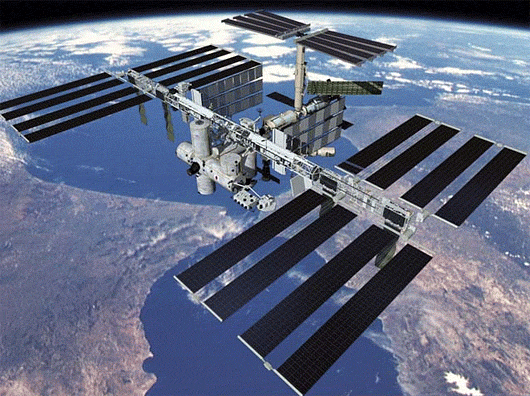
NASA astronauts Rick Mastracchio and Mike Hopkins completed a 5 hour and 28 minute spacewalk Saturday to remove a faulty ammonia pump on the International Space Station. A second spacewalk to install a new unit now is scheduled for Tuesday, Dec. 24.

The extra day will allow time for the crew to resize a spare spacesuit on the space station …

Read the rest of this article

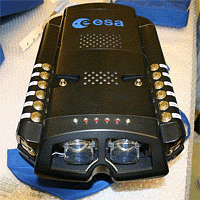
Almost a million people have watched the YouTube video of ESA’s 3D camera being used in space. Here on Earth, the same camera technology is equally successful.

“3D brings a human and immersive feel to images that nothing else can match,” says Max Collon from Dutch Cosine Research and its subsidiary 3D-ONE.

Cosine developed the ERB-1 and ERB-2 Erasmus Recording …

Read the rest of this article

Probe Will Assist Agency in Search for Candidates to Explore

NASA’s Near-Earth Object Wide-field Infrared Survey Explorer (NEOWISE), a spacecraft that made the most comprehensive survey to date of asteroids and comets, has returned its first set of test images in preparation for a renewed mission.

NEOWISE discovered more than 34,000 asteroids and characterized 158,000 throughout the solar system during …

Read the rest of this article

AAVSO AAVSO Alert Notice 494
T Tauri Stars Observing Campaign
December 20, 2013

Darryl Sergison (University of Exeter) has requested AAVSO assistance with a campaign he is carrying out on five T Tauri stars. This study is the one for which AAVSO observers carried out a preliminary campaign last year (see Alert Notice 473 and Special Notice #306). The star list …

Read the rest of this article

ESA’s Gaia mission blasted off this morning on a Soyuz rocket from Europe’s Spaceport in Kourou, French Guiana, on its exciting mission to study a billion suns.

Gaia is destined to create the most accurate map yet of the Milky Way. By making accurate measurements of the positions and motions of 1% of the total population of roughly 100 billion …

Read the rest of this article