There is an old chestnut about a pedestrian who once asked a virtuoso violinist near Carnegie Hall how to get to the famed concert venue. The virtuoso’s answer: practice!

This video shows the scientists’ best guess to date of what the surface of the protoplanet Vesta might look like. It was created as part of an exercise for NASA’s Dawn …

Read the rest of this article

NASA’s Glory mission launched from Vandenberg Air Force Base in California Friday at 5:09:45 a.m. EST failed to reach orbit.

Telemetry indicated the fairing, the protective shell atop the Taurus XL rocket, did not separate as expected about three minutes after launch.

A press briefing to discuss the Glory launch failure is planned at Vandenberg for approximately 8:00 a.m. EST. …

Read the rest of this article

NASA’s Glory spacecraft is scheduled for launch on Friday, March 4. Technical issues with ground support equipment for the Taurus XL launch vehicle led to the scrub of the original Feb. 23 launch attempt. Those issues have been resolved.

The March 4 liftoff from Vandenberg Air Force Base, Calif., is targeted for 5:09:43 a.m. EST, in the middle of a …

Read the rest of this article

Every day about 100 tons of meteoroids — fragments of dust and gravel and sometimes even big rocks – enter the Earth’s atmosphere. Stand out under the stars for more than a half an hour on a clear night and you’ll likely see a few of the meteors produced by the onslaught. But where does all this stuff come from? …

Read the rest of this article

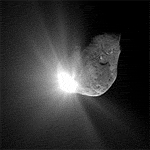
NASA’s Stardust spacecraft returned new images of a comet showing a scar resulting from the 2005 Deep Impact mission. The images also showed the comet has a fragile and weak nucleus.

The spacecraft made its closest approach to comet Tempel 1 on Monday, Feb. 14, at 8:40 p.m. PST (11:40 p.m. EST) at a distance of approximately 178 kilometers (111 …

Read the rest of this article

The Herschel Space Observatory has revealed how much dark matter it takes to form a new galaxy bursting with stars. Herschel is a European Space Agency cornerstone mission supported with important NASA contributions.


A region of the sky called the “Lockman Hole,” located in the constellation of Ursa Major, is one of the areas surveyed in infrared light by the …

Read the rest of this article

Mission controllers at NASA’s Jet Propulsion Laboratory, Pasadena, Calif., watched as data downlinked from the Stardust spacecraft indicated it completed its closest approach with comet Tempel 1. An hour after closest approach, the spacecraft turned to point its large, high-gain antenna at Earth. It is expected that images of the comet’s nucleus collected during the flyby will be received on …

Read the rest of this article

Stars at all stages of development, from dusty little tots to young adults, are on display in a new image from NASA’s Spitzer Space Telescope.

This cosmic community is called the North American nebula. In visible light, the region resembles the North American continent, with the most striking resemblance being the Gulf of Mexico. But in Spitzer’s infrared view, the …

Read the rest of this article

NASA is about to discover how solar heat devours a comet.


Stardust-NExT chases a comet, an artist’s concept. [more]

“For the first time, we’ll see the same comet before and after its closest approach to the sun,” explains Joe Veverka, principal investigator for NASA’s Stardust-NExT mission.

The comet is Tempel 1, which NASA’s Deep Impact probe visited in …

Read the rest of this article

It’s a calm and peaceful night. Stars twinkle in the velvety darkness overhead as a distant plane blinks silently on the horizon. You could almost hear a pin drop.


A camera in Finland caught NanoSail-D flaring on Jan. 30th. The streak of light was almost three times brighter than a 1st-magnitude star. Credit: Esko Lyytinen. [details]

That is, …

Read the rest of this article