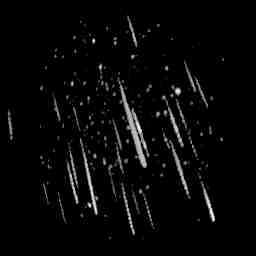
 The Perseid meteor shower is underway and should reach its peak during the next 24 hours. Forecasters say the best time to look is during the dark hours before dawn on Tuesday, August 12th. An 86% full moon will interefere though the Moon will set a couple of hours after midnight. That’s when the Perseids could appear in numbers as high as 60 per hour. The best displays will be seen from rural areas with dark skies.
The Perseids are probably the most-watched annual meteor shower. The shower actually has a very long duration, from about July 15 through August 25 though is most interesting around its peak on August 11-13. This year, the peak comes on August 12 because of it being a leap year. The radiant is above the horizon the entire night for observers north of latitude 32N, but it is fairly low at the end of evening twilight. Evening Perseid rates are fairly low, and the bright Moon makes things worse this year. The real meat of the show comes during the predawn hours when the Moon is down and the radiant is high.

The eastern sky viewed during the hours before sunrise on Tuesday, Aug. 12, 2008.
The source of the shower is Comet Swift-Tuttle. Although the comet is far away, currently located beyond the orbit of Uranus, a trail of debris from the comet stretches all the way back to Earth. Crossing the trail in August, Earth will be pelted by specks of comet dust hitting the atmosphere at 132,000 mph. At that speed, even a flimsy speck of dust makes a vivid streak of light when it disintegrates – a meteor! Because, Swift-Tuttle’s meteors streak out of the constellation Perseus, they are called “Perseids.”
Note: All times below are local. For instance, 9:00 pm means 9:00 pm in your time zone, where you live.)
Serious meteor hunters will begin their watch early, on Monday evening, August 11th, around 9 pm when Perseus first rises in the northeast. This is the time to look for Perseid Earthgrazers – meteors that approach from the horizon and skim the atmosphere overhead like a stone skipping across the surface of a pond.
Earthgrazers are long, slow and colorful and are among the most beautiful of meteors. An hour of watching may net only a few of these at most, but seeing even one can make the whole night worthwhile.
A warm summer night and bright meteors shooting overhead. And the peak is yet to come. What could be better?
The answer lies halfway up the southern sky: Jupiter and the gibbous Moon converge on August 11th and 12th for a close encounter in the constellation Sagittarius. It’s a grand sight visible even from light-polluted cities.
For a while the beautiful Moon will interfere with the Perseids, lunar glare wiping out all but the brightest meteors. The situation reverses itself at about 2 am on Tuesday morning, August 12th, when the Moon sets and leaves behind a dark sky for the Perseids. The shower will surge into the darkness, peppering the sky with dozens and perhaps hundreds of meteors until dawn.
For maximum effect, get away from city lights. The brightest Perseids can be seen from cities but the greater flurry of faint, delicate meteors is visible only from the countryside.
Have something to add to this story? Share it in the comments.
Filed under: Meteors & Meteorites




Don't get hit by the Perseids – the annual meteor shower is expected to produce one or two meteors and fireballs every minute between 10th and 14th August. The ideal night is the one from Sunday to Monday. So instead of getting enough sleep and becoming fit for a new work week snuggle-up in a sleeping bag with your lady and enjoy the fireworks!
You know what’s sad? That people feel like they need ghosts or gods to make the universe seem inspirational or amazing, when it’s pretty damned amazing on its own.The fact that you need to believe in things that don’t exist to distract you from the reality you live in, and that you consider that ‘higher’ thought… Well, that chills me more than any ghost could. To me, the universe is wondrous, and it doesn’t need any spirits, gods, afterlife, or EVPs to make it so. I pity those who are so terrified of non-existence that they need to lie to themselves every day in order to keep going. You know deep down that everything you profess to believe in is sheer fantasy; You can’t be that willfully stupid as to NOT know it’s fantasy, after all… So you lie to yourself, because it chases away the dark thoughts that bounce around in your head as you lay down to sleep every night. Those “what’s it like to not exist?” thoughts that so disturb you.You lie to yourself, and you gather as many other people as you can into the fantasy, because if enough of you lie to yourselves and each other, all together, maybe you can convince yourselves that it’s not a lie, and that since other people are saying it, it must have some truth to it.But it’s a lie. There are no ghosts, and the universe is amazing enough without them. It’s just that YOU, like all other creatures in the universe, are just a speck of dust that will return to the matter from whence you came, and your consciousness– like all others in the universe– will wink out of existence. Just because you are a speck doesn’t mean you’re not an amazing, wondrous thing. It just means you’re no more special than anything else in the universe… And you’re no more eternal, either. All things end. Deal with it, and stop projecting your angst over the truth upon other people who have accepted it.