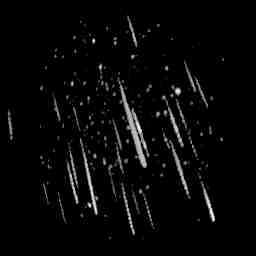
 The annual Perseid meteor shower is about to peak. The show begins after sunset on Tuesday, August 11th, and continues until the sun rises on Wednesday, August 12th.
A time of particular interest is 0800-0900 GMT (1-2 a.m. PDT) on the 12th. That’s when Earth is expected to pass through a denser-than-usual filament of dust from Perseid parent Comet Swift-Tuttle. Forecasters are unsure what will happen, but some have speculated that meteor rates could surge as high as 200 per hour. Bright moonlight will blot out many of those Perseids, but even a fraction of 200 is a good show.
The Perseids are probably the most-watched annual meteor shower. The shower actually has a very long duration, from about July 15 through August 25 though is most interesting around its peak on August 11-13. This year, the peak comes on August 12 because of it being a leap year. The radiant is above the horizon the entire night for observers north of latitude 32N, but it is fairly low at the end of evening twilight. Evening Perseid rates are fairly low, and the bright Moon makes things worse this year. The real meat of the show comes during the predawn hours when the Moon is down and the radiant is high.

The eastern sky viewed during the hours before sunrise on Wednesday, Aug. 12, 2009. Although Perseid meteors can appear in any part of the sky, all of their tails will point back to the radiant.
There is one light you cannot escape on August 12th. The gibbous Moon will glare down from the constellation Aries just next door to the shower’s radiant in Perseus. The Moon is beautiful, but don’t stare at it. Bright moonlight ruins night vision and it will wipe out any faint Perseids in that part of the sky.
The Moon is least troublesome during the early evening hours of August 11th. Around 9 to 11 p.m. local time (your local time), both Perseus and the Moon will be hanging low in the north. This low profile reduces lunar glare while positioning the shower’s radiant for a nice display of Earthgrazers.
Earthgrazers are meteors that approach from the horizon and skim the atmosphere overhead like a stone skipping across the surface of a pond. They are long, slow and colorful – among the most beautiful of meteors. An hour of watching may net only a few of these at most, but seeing even one can make the whole night worthwhile.
The source of the Perseids is Comet Swift-Tuttle. Although the comet is far away, currently located beyond the orbit of Uranus, a trail of debris from the comet stretches all the way back to Earth. Crossing the trail in August, Earth will be pelted by specks of comet dust hitting the atmosphere at 132,000 mph. At that speed, even a flimsy speck of dust makes a vivid streak of light when it disintegrates – a meteor.
For maximum effect, get away from city lights. The brightest Perseids can be seen from cities but the greater flurry of faint, delicate meteors is visible only from the countryside.
The predicted Zenithal Hourly Rate (the number of meteors an observer would see in one hour under a clear, dark sky if the radiant of the shower was directly overhead) is 80-100. In practice, the numbers of meteors actually seen will be lower and the closer the radiant to the horizon, the fewer meteors seen as well.
[phpbay]meteor*, 100, “3239”, “”[/phpbay]
[phpbay]””, 100, “74927”, “”[/phpbay]
[phpbay]””, 100, “74922”, “”[/phpbay]
Meteor Videos:
[tubepress mode=”tag” tagValue=”meteors meteorite”]
Amazon.com BestSellers
| [phpzon keywords=”meteors” searchindex=”Books” num=”3″] |
Filed under: Meteors & Meteorites




Don't get hit by the Perseids – the annual meteor shower is expected to produce one or two meteors and fireballs every minute between 10th and 14th August. The ideal night is the one from Sunday to Monday. So instead of getting enough sleep and becoming fit for a new work week snuggle-up in a sleeping bag with your lady and enjoy the fireworks!
I once climbed Mt. Lemmon to watch the Perseid meteor shower (which is August, I know) and I couldn't imagine a more lovely place to see stars. Someone told me I looked like a gypsy that night, and I felt like one, wandering amongst the stars.
I love traditions and rituals. I wish I could find one that was sufficiently earthy and witchy and important for Lucy's day. That is what I search for these days: a ritual.
I have to say doing something star-related every year sounds amazing. Camping and sleeping under the stars…perhaps?