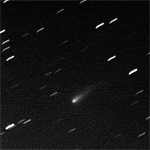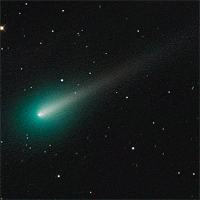
Hopes are high for Comet ISON, which has the potential to become the most spectacular comet seen in years. ISON is speeding through the inner solar system at about 120,000 miles per hour, on its way to a close approach to the Sun on November 28th. Assuming it survives its close encounter, it could become easily visible to the unaided …

Read the rest of this article

Just a couple of days ago, Comet ISON was ten times brighter than it was on Nov. 13-14 when an unexpected outburst propelled the sundiver into the realm of naked-eye visibility.

Observers around the world confirmed seeing the comet as a faint smudge low in the eastern sky before sunrise.

Backyard telescopes revealed a riot of gaseous streamers trailing behind …

Read the rest of this article

What are the odds? On Nov. 18th and 19th not one but two comets will fly by the planet Mercury.

“This is a unique coincidence,” says Ron Vervack an astronomer at the Johns Hopkins University Applied Physics Lab and a member of the science team for NASA’s MESSENGER spacecraft, “and a golden opportunity to study two comets passing close to …

Read the rest of this article

Comet ISON is brightening as it approaches the sun. Multiple observers now report that it is a binocular object. “I finally saw Comet ISON for the first time using small binoculars!” says pilot Brian Whittaker. He was flying 38,000 feet over the Mediterranean Sea on Nov. 8th at the time.

“It was faint, but is predicted to brighten and move …

Read the rest of this article

Observations indicate that the sudden exposure to strong sunlight when the currently dark side of the comet gets closer to the Sun could trigger huge outbursts.

Scientists are unraveling more information on Comet ISON (C/2012 S1) as it continues on its journey toward the Sun. ISON will skim 730,000 miles (1.3 million kilometers) above the Sun’s surface November 28 and …

Read the rest of this article

The countdown clock is ticking to comet ISON’s hair-raising passage around the sun on Nov. 28, as it grazes the sun at a distance of only 1.5 times the sun’s radius. Astronomers continue reworking estimates of how much of an impression the far visitor will make to Earthbound observers.

The prognostication is so chancy that I couldn’t even get comet-hunting …

Read the rest of this article

A useful point of comparison is Comet Lovejoy, which put on a grand show after it brushed the sun in 2011. People in the southern hemisphere still remember the comet’s tail stretching halfway across the night sky. Judging from the brightness of Comet ISON, Matthew Knight of the Lowell Observatory believes that “ISON is likely a few times bigger than …

Read the rest of this article

ESA’s space missions are getting ready to observe an icy visitor to the inner Solar System: Comet ISON, which might also be visible in the night sky later this year as a naked eye object.

The comet was discovered in images taken on 21 September 2012 by astronomers Artyom Novichonok and Vitali Nevski using a 40 cm-diameter telescope that is …

Read the rest of this article

Comets and other icy celestial bodies have some basic building blocks for life, but it takes violent impacts to take them to the next level, according to researchers who claim to have successfully created amino acids in the lab by recreating icy interplanetary collisions.

First the researchers created mixtures of water ice and light organic chemicals roughly based on what …

Read the rest of this article

Around the world, astronomers are buzzing with anticipation over the approach of Comet ISON. On Thanksgiving Day 2013, the icy visitor from the outer solar system will skim the sun’s outer atmosphere and, if it survives, could emerge as one of the brightest comets in years.

First, though, it has to fly by Mars.

“Comet ISON is paying a visit …

Read the rest of this article