Rosetta Mission

Comet 67P/Churyumov-Gerasimenko is releasing the Earthly equivalent of two glasses of water into space every second. The observations were made by the Microwave Instrument for Rosetta Orbiter (MIRO), aboard the European Space Agency’s Rosetta spacecraft on June 6, 2014. The detection of water vapor has implications not only for cometary science, but also for mission planning, as the Rosetta team …

Read the rest of this article

Rosetta Mission

ESA’s Rosetta spacecraft has caught a first glimpse of its destination comet since waking up from deep-space hibernation on 20 January.

These two ‘first light’ images were taken on 20 and 21 March by the OSIRIS wide-angle camera and narrow-angle camera, as part of six weeks of activities dedicated to preparing the spacecraft’s science instruments for close-up study of comet …

Read the rest of this article

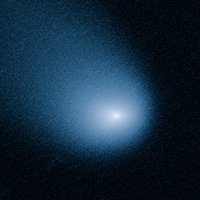
Comet Siding Spring is plunging toward the Sun along a roughly 1-million-year orbit. The comet, discovered in 2013, was within the radius of Jupiter’s orbit when the Hubble Space Telescope photographed it on March 11, 2014. Hubble resolves two jets of dust coming from the solid icy nucleus. These persistent jets were first seen in Hubble pictures taken on Oct. …

Read the rest of this article

A team of European astronomers has found a previously unknown comet, detected as a tiny blob of light orbiting our Sun deep in the Solar System.

Europe’s Teide Observatory Tenerife Asteroid Survey team has been credited with discovering comet P/2014 C1, named ‘TOTAS’ in recognition of the teamwork involved in the find.

The comet was unexpectedly discovered on 1 February …

Read the rest of this article

A comet heading towards Earth threatens humanity’s existence – that was the virtual scenario of this year’s Zero Robotics tournament. Secondary-school students from across Europe controlled miniature satellites on the International Space Station in a competition to save our planet.

The Space Station was turned into a playing field for the finals. The ultimate robot game challenged youngsters to write …

Read the rest of this article

Rosetta Mission

Comets are among the most beautiful and least understood nomads of the night sky. To date, half a dozen of these most heavenly of heavenly bodies have been visited by spacecraft in an attempt to unlock their secrets. All these missions have had one thing in common: the high-speed flyby. Like two ships passing in the night (or one ship …

Read the rest of this article

Rosetta Mission

On Monday, 20 January, 807 million km away, Rosetta is set to wake up from 31 months of deep-space hibernation. Here on Earth, the mission control team will be waiting to catch its signal in the Main Control Room, at ESOC, ESA’s Space Operations Centre, Darmstadt, Germany.

As Europe’s centre of excellence for mission operations, the European Space Operations Centre …

Read the rest of this article

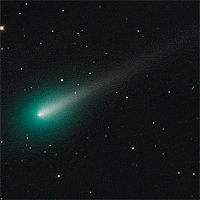
I’ve held off posting about Comet ISON’s fate following its close encounter with the Sun as conflicting reports about whether it survived the encounter or not have been flying about since last night.

The giant ball of ice and dust was initially declared dead when it failed to re-emerge from behind the star with the expected brightness. But recent pictures …

Read the rest of this article

Comet C/2012 S1 was discovered in September 2012 by Russian astronomers Vitali Nevski and Artyom Novichonok using data from the International Scientific Optical Network (ISON). For that reason, it is also known as Comet ISON. This comet is on a close encounter with the Sun on November 28, 2013 (Thanksgiving day in the U.S.), when it will pass at a …

Read the rest of this article

In 2007, astronomers were amazed when a solar storm hit Comet Encke. NASA STEREO spacecraft watched as a CME (coronal mass ejection) struck the comet head on and ripped off its tail.

The same thing could be in store for Comet ISON – only worse.

On Nov. 28th, Comet ISON will pass through the sun’s atmosphere, flying little more than …

Read the rest of this article