The solar eruption of August 7th might affect Earth after all. Newly-arriving data from the Solar and Heliospheric Observatory (SOHO) show a CME heading our way with a significant Earth-directed component. High-latitude sky watchers should be alert for auroras when the cloud arrives on August 10th. A movie of the CME is featured on today’s edition of http://spaceweather.com.
[phpbay]solar telescop*, 100, “”, “”[/phpbay]
Variable Star Videos:
[tubepress mode=”tag” tagValue=”astronomy solar flare”]
Amazon.com BestSellers
| [phpzon keywords=”observing the sun” num=”3″] |
Filed under: Astronomy News • The Sun


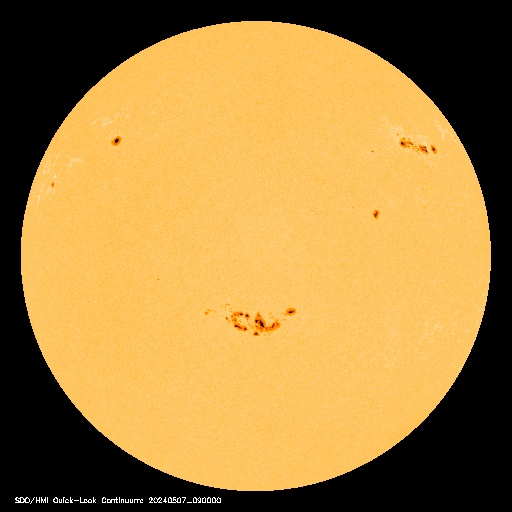
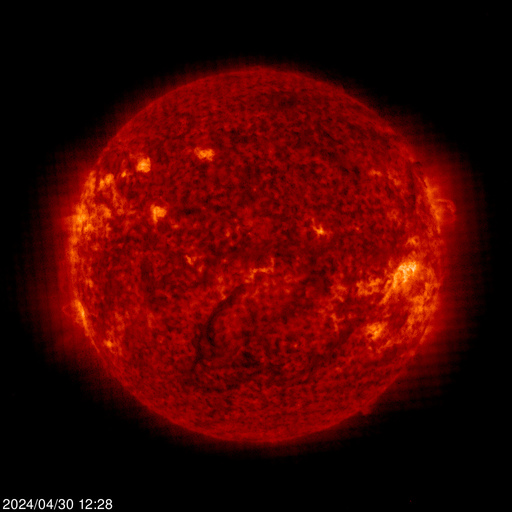
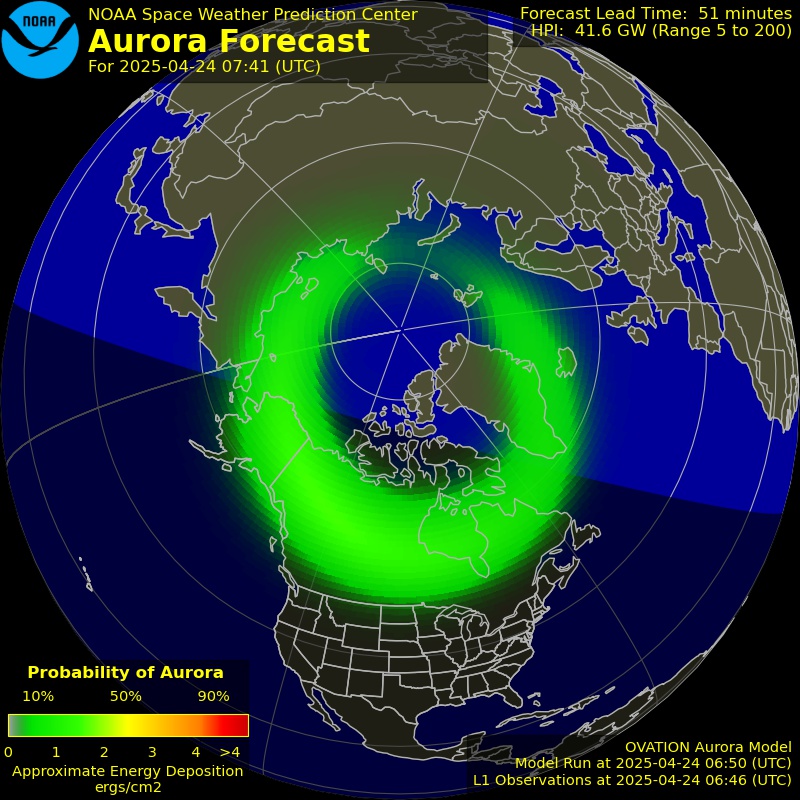
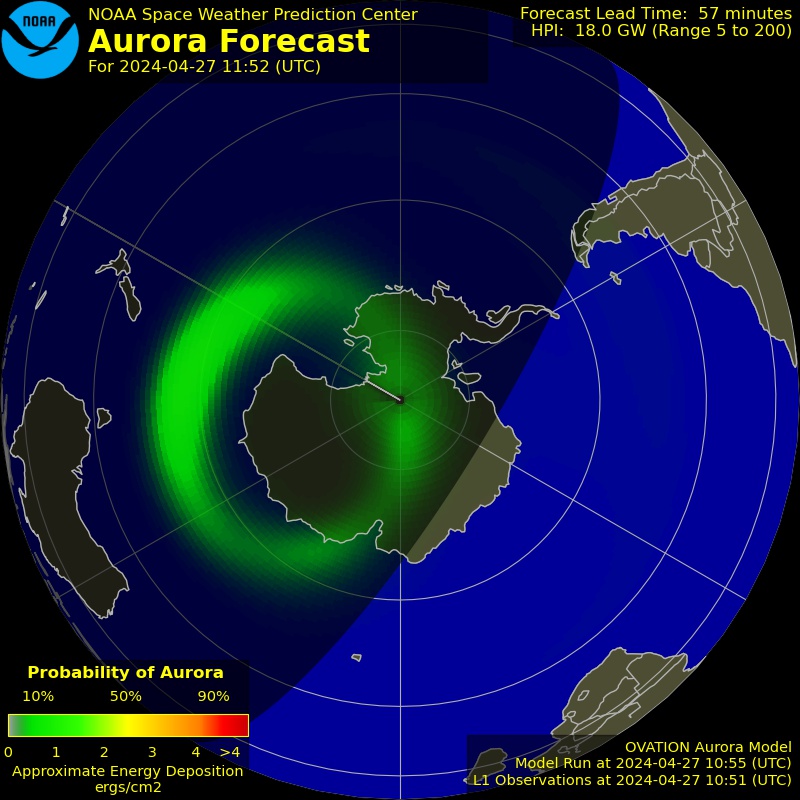
Coronal mass ejections (CMEs) occur all the time. Most of them do absolutely nothing to the earth, since they're aimed in different directions. Of the ones that do reach the earth, more than 99% of them do no more than brighten the aurora. The earth's magnetic field acts as a deflector shield, diverting most of the charged particles away from the earth's surface. On rare occasions, CMEs are strong enough that the charged particles distort the magnetic field, which creates electric current flows in the long, continuous wiring system that makes up the power grid. A CME in 1989 caused power failures in parts of Canada, and a larger CME could do far more damage. Fortunately, CMEs can be detected before they reach the earth, and simple measures (circuit breakers, basically) can protect the power grid by temporarily breaking it down into smaller parts when a CME is due to arrive.
The film "Knowing" is pure fiction.
I'm observing the Sun on my iPhone – AIA 304 SDO
We do have satellites out there. One of them is SOHO – Solar and Heliospheric Observatory: That link describes more about it’s position. It’s not orbiting the Earth, it’s basically orbiting the sun alongside the earth in what they call a “halo orbit”. You can read more about Lagrangian Points here: Lagrange points are basically “stable” points between large masses, say, the Sun and Earth, where the gravity of one object cancels out the gravity of the other one and they’re sort of equally pulling on each other. Which means you can “park” a satellite or spacecraft there and it’ll more or less stay there. This is different then most satellites orbiting the Earth (or Sun) because the objects at an L-point aren’t actually orbiting. IE, they don’t need to keep “falling” around a planet’s gravitational pull. Even the communication satellites we park in “geostationary” orbit are still orbiting. They’re just orbiting at exactly the right speed and distance that they stay over the same spot on the Earth because they match the Earth’s rotation speed. To us on the ground it looks like they’re just hanging there in the sky, stationary – but they’re really moving very fast at a much farther distance. (Much farther then, say, the Shuttle or ISS, but not nearly as far as the L1 or L2 points near the Earth.) Also, make sure you scroll down on the Lagrangian Points wiki page and see the list of spacecraft we’ve parked at L-points. There’s been a few.
“GREAT FILAMENT, CONTINUED: For the seventh day in a row, an enormous magnetic filament is hanging suspended above the surface of the sun’s southern hemisphere. The Solar and Heliospheric Observatory (SOHO) has a great view. How long can it last? Solar filaments are unpredictable. If this one collapses and hits the stellar surface, the impact could produce a powerful Hyder flare. Readers with solar telescopes are encouraged to monitor developments.”
“A group of astronomers led by the University of Hawaii’s Dr. Jeff Kuhn has found that in recent times the sun’s size has been remarkably constant. Its diameter has changed by less than one part in a million over the last 12 years.
“This constancy is baffling, given the violence of the changes we see every day on the sun’s surface and the fluctuations that take place over an 11-year solar cycle,†commented Kuhn, the associate director of the University of Hawaii Institute for Astronomy (IfA) who is responsible for Haleakala Observatories.
Kuhn’s work is part of worldwide efforts to understand the influence of the sun on Earth’s climate. “We can’t predict the climate on Earth until we understand these changes on the sun,†he said.
Kuhn and his colleagues (Dr. Rock Bush from Stanford, Dr. Marcelo Emilio from Brazil, and Dr. Isabelle Scholl at IfA) used NASA’s long-lived Solar and Heliospheric Observatory (SOHO) satellite to monitor the sun’s diameter, and they will soon repeat the experiment with much greater accuracy using NASA’s new Solar Dynamics Observatory (SDO), which was launched on February 11. According to Kuhn, the ultimate solution to this puzzle will depend on probing the smallest observable scales of the solar surface using the Advanced Technology Solar Telescope (ATST), which is scheduled for completion on Haleakala in 2017.
“To be able to predict what the sun will do, we need both the big picture and the details,†said Kuhn. “Just as powerful hurricanes on Earth start as a gentle breeze, the analogs of terrestrial storms on the sun start as small kinks in the sun’s magnetic field.â€
That's the University of Hawaii's account.
[…] Coronal Mass Ejection (CME) from our Sun – a CME was behind the solar storm of 1859. It occurred in September of that year, causing the failure of telegraph systems across North America and Europe. Accompanying the storm were auroras that are normally only seen in the Arctic and Antarctic, but were visible as far south as the Caribbean. Typically we would expect a storm of You may also find this relevant: […]