Lunar Eclipse: February 21 2008
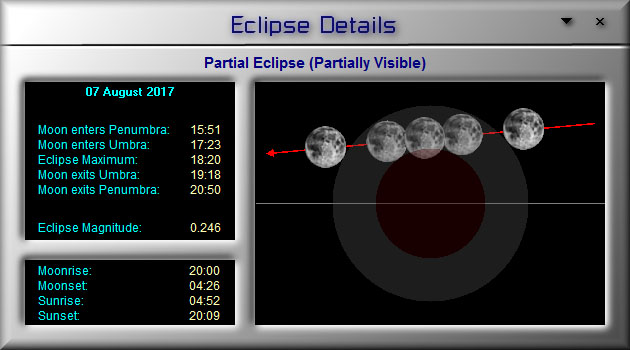
This month sees the first of two lunar eclipses this year. While the eclipse this month is a total eclipse, August sees only a partial eclipse. February’s eclipse details are shown below. Times are in UT. The diagram (slightly reduced in size) was created with LunarPhase Pro.
In a Total Lunar Eclipse the Full Moon passes into the shadow of the Earth and dims very considerably and changes color, but usually remains faintly visible, lit by sunlight refracted through the Earth’s atmosphere. The atmosphere scatters blue light more than red, so that most of the light that reaches the lunar surface is red in color. Observers will therefore see a Moon that may be anything from brick-colored, through orange, rust-colored, or even blood red. Sometimes it has a dark greyish hue, depending on atmospheric conditions.

Click for larger image
The eclipse begins at 00:37 UT when the Moon enters the penumbra, the lightest, outer part of the Earth’s shadow, and after 15 minutes or so you may notice the Moon start to take on a slight yellowish hue. At 01:43 UT the Moon starts to enter the dark core of the Earth’s shadow, the umbra. At 03:00 the Moon will be completely within the umbra – which marks the start of the ‘total’ phase of the eclipse, when any color starts to become most noticeable. Mid-eclipse is at 03:26 UT and the total phase ends at 03:51 UT. The Moon leaves the umbra at 05:07 UT and the eclipse ends when the Moon leaves the penumbra at 06:13 UT.
The Moon will pass well to the South of the centre of the Earth’s shadow, so the Southern edge (actually the SSW edge) of the Moon will not appear so dark, as it will be closer to the edge of the shadow. Conversely, the NNE edge of the Moon will appear darkest.
During the eclipse the Moon lies in the constellation of Leo. During mid-eclipse Regulus will lie to the upper right of the Moon and Saturn will lie to the left.
This eclipse should be a spectacular sight and the whole event can be observed without optical aid, although binoculars or a wide-field telescope will also give interesting views.
Other Colors
Red isn’t the only color to look for when the Moon glides through Earth’s shadow. Observers of several recent lunar eclipses have reported a flash of turquoise.
The source of the turquoise is ozone. Earth’s ozone layer absorbs red sunlight while allowing blue rays to pass. This has the effect of turning Earth’s shadow turquoise-blue around the edges. Look for it during the first and last minutes of totality (03:00 UT and 03:51 pm UT).
- Live webcasts: from the Canary Islands; from Norway; from Iran; from Columbus, Georgia; from the Netherlands; from Belgium;
- Timetables: (pick your time zone)
GMT
AST
EST
CST
MST
PST
Alaska
Hawaii - NASA links: worldwide visibility, full story
[phpbay]observing moon, 100, “378”, “”[/phpbay]
Lunar Eclipse Videos:
[tubepress mode=”tag” tagValue=”Lunar Eclipse astronomy”]
| [phpostock]Lunar Eclipse,1[/phpostock] |