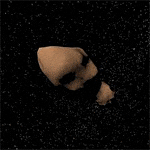
This week, NASA’s Goldstone radar is tracking a large asteroid as it passes by Earth, and obtaining unusually clear images of the tumbling space rock.

“There is no danger of a collision with Earth,” says Lance Benner of NASA’s Near Earth Object Program. “At closest approach on Dec. 12th, asteroid 4179 Toutatis was 7 million km away or 18 times …

Read the rest of this article
Deep in the heart of the spiral Milky Way galaxy, a hot vortex of matter swirls around a black hole more than a million times as massive as the sun. Many galaxies, perhaps all, contain such a “monster in the middle.” These supermassive black holes sustain themselves by swallowing stars, planets, asteroids, comets and clouds of gas that wander by …

Read the rest of this article

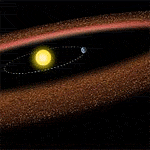
Solar systems with life-bearing planets may be rare if they are dependent on the presence of asteroid belts of just the right mass, according to a study by Rebecca Martin, a NASA Sagan Fellow from the University of Colorado in Boulder, and astronomer Mario Livio of the Space Telescope Science Institute in Baltimore, Md.


This illustration shows three possible scenarios …

Read the rest of this article

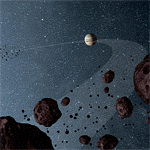
Scientists using data from NASA’s Wide-field Infrared Survey Explorer, or WISE, have uncovered new clues in the ongoing mystery of the Jovian Trojans — asteroids that orbit the sun on the same path as Jupiter. Like racehorses, the asteroids travel in packs, with one group leading the way in front of the gas giant, and a second group trailing behind.…

Read the rest of this article

Planetary Resources are looking for passionate college students for paid co-op positions to help them mine asteroids this coming spring and summer…

If you love space and want to contribute directly to the development of the next generation of space exploration technologies, they want to hear from you (or from anyone you know that you think would be interested).

Click

Read the rest of this article

Surprisingly, most amateur astronomers have never seen as asteroid. But this week Asteroid 2 Pallas, the second one discovered, and the second biggest, will make a very close pass to the mag. 3.5 star Iota Ceti (also sometimes known as Deneb Kaitos Shemali, or Deneb Kaitos Al Shamaliyy) on 29 September. Pallas will be magnitude 8.3, so almost 5 …

Read the rest of this article

Progress continues with Planetary Resources, the private syndicate that proposes to mine asteroids in the near future for rare metals. Here’s their latest communication:

We’ve been working our tails off at Planetary Resources planning our initial launches of our first spacecraft.

We call these first Asteroid finding spacecraft Arkyd Series-100 (next email we’ll tell you where the name ‘Arkyd’ comes …

Read the rest of this article

A scientist at NASA’s Jet Propulsion Laboratory in Pasadena, Calif., has accurately determined the mass of a nearby asteroid from millions of miles away. The celestial equivalent of “guess your weight” was achieved by Steve Chesley of JPL’s Near-Earth Object Program Office by utilizing data from three NASA assets – the Goldstone Solar System Radar in the California desert, the …

Read the rest of this article

A partnership with the UK’s Faulkes Telescope Project promises to boost the Agency’s space hazards research while helping students to discover potentially dangerous space rocks.


2m Faulkes North Telescope at Haleakalā, Hawaii, USA. Credits: Faulkes Telescope Project

ESA’s Space Situational Awareness (SSA) programme is keeping watch over space hazards, including disruptive space weather, debris objects in Earth orbit and asteroids …

Read the rest of this article
Asteroid 2003 UV11 will fly past Earth on Oct. 29th and 30th (2010) at a distance of only 1.2 million miles. Its minimum (closest) approach to Earth happens at 02:24:00 Greenwich Mean Time (GMT) on October 30th.

Experienced amateur astronomers should have little trouble photographing the 600-meter wide space rock as it glides through the constellation Pegasus on Friday night, …

Read the rest of this article