Herschel opened its ‘eyes’ on 14 June and the Photoconductor Array Camera and Spectrometer obtained images of M51, ‘the whirlpool galaxy’ for a first test observation. Scientists obtained images in three colours which clearly demonstrate the superiority of Herschel, the largest infrared space telescope ever flown.
|
Red, green and blue correspond to the 160-micron, 100-micron and 70-micron wavelength bands of the Herschel’s Photoconductor Array Camera and Spectrometer, PACS. Glowing light from clouds of dust and gas around and between the stars is visible clearly. These clouds are a reservoir of raw material for ongoing star formation in this galaxy. Blue indicates regions of warm dust that is heated by young stars, while the colder dust shows up in red. Credits: ESA and the PACS Consortium |
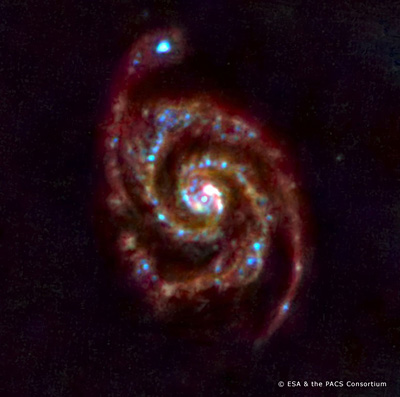
This image shows the famous ‘whirlpool galaxy’, first observed by Charles Messier in 1773, who provided the designation Messier 51 (M51). This spiral galaxy lies relatively nearby, about 35 million light-years away, in the constellation Canes Venatici. M51 was the first galaxy discovered to harbour a spiral structure.
The image is a composite of three observations taken at 70, 100 and 160 microns, taken by Herschel’s Photoconductor Array Camera and Spectrometer (PACS) on 14 and 15 June, immediately after the satellite’s cryocover was opened on 14 June.
Herschel, launched only a month ago, is still being commissioned and the first images from its instruments were planned to arrive only in a few weeks. But engineers and scientists were challenged to try to plan and execute daring test observations as part of a ‘sneak preview’ immediately after the cryocover was opened. The objective was to produce a very early image that gives a glimpse of things to come.
|
|

To the left is the best image of M51, taken by NASA’s Spitzer Space Telescope, with the Multiband Imaging Photometer for Spitzer (MIPS), juxtaposed with the Herschel observation on 14 and 15 June at 160 microns. The obvious advantage of the larger size of the telescope is clearly reflected in the much higher resolution of the image: Herschel reveals structures that cannot be discerned in the Spitzer image.
|
|
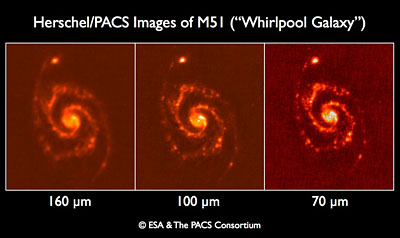
Herschel’s glimpse of M51 at 70, 100, 160 microns.
These images clearly demonstrate that the shorter the wavelength, the sharper the image — this is a very important message about the quality of Herschel’s optics, since PACS observes at Herschel’s shortest wavelengths.
Produced from the very first test observation, these images lead scientists to conclude that the optical performance of Herschel and its large telescope is so far meeting their high expectations.
Background to the Mission: Kourou, May 14, 2009
On Thursday, May 14, Arianespace’s second mission of the year successfully launched two scientific satellites for the European Space Agency (ESA): the Herschel space telescope and the Planck scientific observatory.
44th Ariane 5 launch, 30th success in a row
The two satellites are being launched towards the L2 Lagrange point, once again demonstrating the operational capabilities of Ariane 5. This is the only launch vehicle on the commercial market today capable of launching two payloads simultaneously and handling a complete array of missions, from commercial launches into geostationary orbit, to scientific missions into special orbits.
Herschel/Planck mission at a glance
The mission was carried out by an Ariane 5 ECA launcher from Europe’s Spaceport in Kourou, French Guiana. Liftoff was on Thursday, May 14, 2009 at 10:12 am local time in Kourou (13:12 UT, 3:12 pm in Paris, 9:12 am in Washington, D.C. and 5:12 pm in Moscow).
Once injected into transfer orbit, the two satellites will independently move to their operational orbits around the L2 Lagrange point in the Earth-Sun system, at 1.5 million kilometers from Earth, on the side away from the Sun.
Herschel and Planck scientific satellites
Herschel space telescope: a follow-on to the ISO (Infrared Space Observatory) program, the Herschel space telescope has two main objectives: observation of the “cold†Universe, in particular the formation of stars and galaxies; and studying the chemical composition of atmospheres around celestial bodies and the molecular chemistry of the Universe. Herschel’s mirror, at 3.5 meters in diameter, is the largest ever deployed in space. The spacecraft weighed 3,402 kg at launch.
Planck scientific satellite: the Planck scientific observatory is designed to analyze the remnants of the radiation that filled the Universe immediately after the Big Bang, which we observe today as the cosmic microwave background, offering unprecedented sensitivity and resolution. Planck will provide vital information concerning the creation of the Universe and the origins of the cosmic structure. It weighed 1,921 kg at launch.
Both Herschel and Planck were built by Thales Alenia Space as prime contractor.
| More Information | |||||
| Herschel Mission (ESA) – European Space Agency home page for the Herschel mission. Herschel Mission (JPL) – Jet Propulsion Laboratory home page for the Herschel mission. Planck Mission (ESA) – European Space Agency home page for the planck mission. Planck Mission (ESA) – Caltech’s home page for the Planck Mission. MPAC – MPA Planck Analysis Centre – A hub page leading to other institutions than have connections with the Planck Mission. |
|||||
[phpbay](herschel|planck) telescope, 100, “”, “”[/phpbay]
Herschel/Planck Mission Videos:
[tubepress mode=”tag” tagValue=”herschel planck mission”]
| [phpostock]space telescope,1[/phpostock] |
Filed under: Space Telescopes




A light year, of course, refers to the distance light can travel during a standard year on Earth, which works out to be about 5,878,625,373,183.61 (that's five trillion, eight hundred seventy-eight billion, six hundred twenty-five million, three hundred seventy-three thousand, one hundred eighty three point six one) miles.
A planet thirteen million light years away from us would be in the proverbial "galaxy far, far away" on out past Andromeda and the Magellanic clouds (our nearest galactic neighbors, and none more than two and a half million or so light years away), and a bit on the far side of the M81 group of galaxies– which is a perfectly lovely area of space if you happen to be heading in that direction– but make sure to stock up on extra fuel and snacks, and take a long bathroom break before you head out, because you'll be traveling 76,422,129,851,386,930,000 (seventy-six quintillion, four hundred twenty-two quadrillion, one hundred twenty-nine trillion, eight hundred fifty-one billion, three hundred eighty-six million, nine hundred thirty thousand) miles as the obviously immortal crow flies.
NASA's series of Great Observatories satellites are four large, powerful space-based telescopes. They are named after the four astro-physicist's shown in the question.
Hubble Space Telescope, named after Edwin Hubble.
Compton Gamma Ray Observatory, named after Arthur Holly Compton.
Chandra X-ray Observatory, named after Subramanya Chandrashakar.
Spitzer Space Telescope, named after Lyman Spitzer, Jr.
It is not true that matter can only travel 1-5 percent of the speed of light. We routinely accelerate muons–mu mesons–in particle accelerators up to close to the speed of light. This is one of the ways we have tested (and corroborated) Einstein's special theory of relativity.
The redshift of the light from distant galaxies occurs because the space between galaxies is being stretched apart. This is not the case for galaxies within our local group, but it occurs on vaster scales.
If you are curious about the measurements–we managed to trigonometrically measure the distance to a star (Sanduleak -69 202) in the Large Magellanic Cloud to about 170,000 light years.
We also know our galaxy has more than 200 billion stars. With the average size and distance between stars, and the gravitational effects between them, this requires our galaxy to be of a certain size–roughly 100,000 light years across. We can also use the size and distribution of stars in the LMC to estimate the distance to our sister galaxy, Andromeda–at just over 2 million light years.
Then there are 100 billion galaxies in our universe. Given their size and distribution, that places constraints upon the possible size and age of our universe. However, the best age estimates have come from the COBE and WMAP satellites upon examination of the data they have collected on the microwave background radiation (MBR).
This has been determined to be 13.7 billion years.
The furthest galaxies we can see are estimated to be more than 13.7 billion light years away, because of the expansion of space.
A light year is the distance that light travels in one year's time, or roughly 5,879,000,000,000 miles.
13 million light years would be equivalent to ~7,642,700,000,000,000,000,000 miles.
First of all, the expansion of space is not limited by the speed of light. We estimate the universe is about 13.7 billion years old. In all that time it has been expanding. A distant galaxy that shows a large amount of red shift is measured to be, say 10 billion light years away. That is "look back" time. The actual distance may be more like 40 billion light years. In other words, the light we're seeing now from that object left 10 billion years ago. Since that time that object has evolved and space has expanded even more.
The nearest large spiral galaxy to our own, the Andromeda Galaxy, is 2.6 million light years away. On a scale of billions of years of time, this is not much time for light to have traveled from there to here, and this galaxy is indeed gravitationally bound with ours and is a next door neighbor.
The thing to stress is that it is empty space that is expanding, and that expansion is not limited to the speed of light. Indeed, according to Hubble's law, the reason we can only see so far into the universe is because the further things are away from us, the faster they are receding from us. Our "horizon" is where things are receding from us at greater than light speed.
If you study Inflation Theory put forth by respected astrophysicist Alan Guth, it is that in the very early beginnings, at the tiniest imaginable fraction of a second of when time first began, the universe expanded exponentially, much faster than light speed. This theory dovetails well with Big Bang theory. Cosmology is complicated and sounds absurd when you try to explain it in simple terms. There is much free reading available on the subject just over the Internet alone, but a subscription to Astronomy Magazine is fun and enlightening, and Tim Ferris' cosmology novel "The Whole Shebang" covers your question quite well when it discusses the "horizon problem" and the cosmic microwave background radiation, those light echoes from the Big Bang that were accidentally discovered a few decades ago.