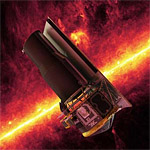
Astronomers have found cosmic clumps so dark, dense and dusty that they throw the deepest shadows ever recorded. Infrared observations from NASA’s Spitzer Space Telescope of these blackest-of-black regions paradoxically light the way to understanding how the brightest stars form.

The clumps represent the darkest portions of a huge, cosmic cloud of gas and dust located about 16,000 light-years away. …

Read the rest of this article

Mars

NASA and its international partners now have the go-ahead to begin construction on a new Mars lander, after it completed a successful Mission Critical Design Review on Friday.

NASA’s Interior Exploration Using Seismic Investigations, Geodesy and Heat Transport (InSight) mission will pierce beneath the Martian surface to study its interior. The mission will investigate how Earth-like planets formed and developed …

Read the rest of this article

After eight years in orbit, ESA’s Venus Express has completed routine science observations and is preparing for a daring plunge into the planet’s hostile atmosphere.

Venus Express was launched on a Soyuz–Fregat from the Russian Baikonur Cosmodrome in Kazakhstan on 9 November 2005, and arrived at Venus on 11 April 2006.

It has been orbiting Venus in an elliptical 24-hour …

Read the rest of this article

Chandra X-Ray Observatory

A new idea to use super-polished silicon wafers as the heart of a telescope is set to reveal more of the hot, high-energy Universe, peering back into its turbulent history.

Invisible X-rays tell us about the very hot matter in the Universe – black holes, supernovas and superheated gas clouds. Today’s X-ray observatories, ESA’s XMM-Newton and NASA’s Chandra, were launched …

Read the rest of this article

What happens when two neutron stars collide? Using a sophisticated computer simulation, NASA scientists have visualized this violent scenario in awesome degenerate-matter-crushing detail.

Neutron stars are the result of supernovae spawned by stars 8-30 times the mass of our sun. Occasionally, however, two neutron stars may meet, becoming entangled in a deep gravitational embrace. Should this scenario play out, one …

Read the rest of this article

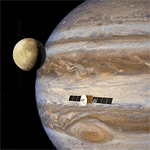
Jupiter’s trademark Great Red Spot — a swirling anti-cyclonic storm larger than Earth — has shrunk to its smallest size ever measured.

According to Amy Simon of NASA’s Goddard Space Flight Center in Greenbelt, Maryland, recent NASA Hubble Space Telescope observations confirm the Great Red Spot   now is approximately 10,250 miles across. Astronomers have followed this downsizing since the 1930s.…

Read the rest of this article

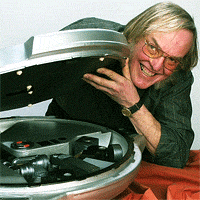
British planetary scientist Professor Colin Pillinger, a former ESA principal investigator, died on May 7th. He suffered a brain haemorrhage at his home in Cambridge and died in hospital.

Pillinger, who was awarded the CBE in 2003, was an unconventional scientist who understood the value of showmanship to sell big ideas to the public.

The Open University scientist was best …

Read the rest of this article

Last month (April 8-11), scientists, government officials, emergency planners and others converged on Boulder, Colorado, for NOAA’s Space Weather Workshop—an annual gathering to discuss the perils and probabilities of solar storms.

The current solar cycle is weaker than usual, so you might expect a correspondingly low-key meeting.  On the contrary, the halls and meeting rooms were abuzz with excitement about …

Read the rest of this article

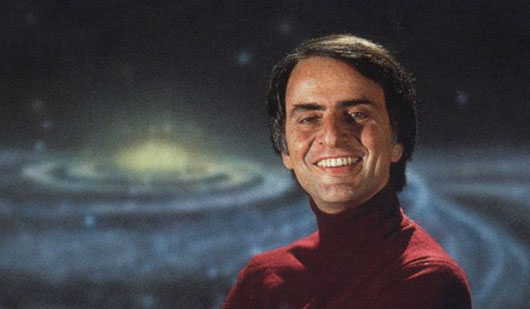
I remember being glued to the TV just after Christmas in 1977 as Carl Sagan delivered that years’s Royal Institution Christmas Lectures. This was in the days before Video Cassette Recorders (at least affordable ones), so I recorded the six lectures on audio cassette. Many, many years later, while cleaning out the attic (loft), I came across those recordings.

Wanting …

Read the rest of this article

AAVSO AAVSO Alert Notice 501
Predicted occultation of Regulus
April 30, 2014

Dr. Peter Garnavich (University of Notre Dame) and Dr. Paula Szkody (University of Washington) have requested the help of AAVSO observers in monitoring the cataclysmic variable SBS 1108+574 (= CSS 120422:111127+571239) in support of upcoming Hubble Space Telescope observations. The HST COS (Cosmic Origins Spectrograph) will be carrying out …

Read the rest of this article