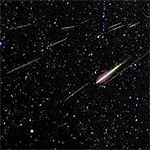
Waking up before sunrise is a good way to get a head start on the day. On Oct. 21st, waking up before sunrise could stop you in your tracks.

Blame Halley’s Comet. Every year in mid-to-late October, Earth passes through a stream of dusty debris from Comet Halley, and the pre-dawn sky can light up with a pretty display of …

Read the rest of this article

This weekend, Comet Siding Spring (C/2013 A1) will make a historically close approach to Mars. Satellites and rovers will get an eye-full as the green comet passes less than 140,000 km (87,000 miles) above the Red Planet’s surface. No one knows what will happen. Possible side-effects of the flyby include a Martian meteor shower and auroras. These videos from a …

Read the rest of this article

This weekend, Comet Siding Spring (C/2013 A1) will make a historically close approach to Mars. Satellites and rovers will get an eye-full as the green comet passes less than 140,000 km (87,000 miles) above the Red Planet’s surface. No one knows what will happen. Possible side-effects of the flyby include a Martian meteor shower and auroras.

Europe’s Mars orbiter and …

Read the rest of this article

Three views of an escaping atmosphere (click image for larger view), obtained by MAVEN’s Imaging Ultraviolet Spectrograph, are shown here. By observing all of the products of water and carbon dioxide breakdown, MAVEN’s remote sensing team can characterize the processes that drive atmospheric loss on Mars. These processes may have transformed the planet from an early Earthlike climate to the …

Read the rest of this article

Many celestial objects are beautiful – swirling spiral galaxies or glittering clusters of stars are notable examples. But some of the most striking scenes are created during the death throes of intermediate-mass stars, when great clouds of superheated gas are expelled into space. These dying breaths form planetary nebulas like NGC 6302, captured here in this image from the NASA/ESA …

Read the rest of this article

NASA’s extensive fleet of science assets, particularly those orbiting and roving Mars, have front row seats to image and study a once-in-a-lifetime comet flyby on Sunday, Oct. 19.

Comet C/2013 A1, also known as comet Siding Spring, will pass within about 87,000 miles (139,500 kilometers) of the Red Planet — less than half the distance between Earth and our moon …

Read the rest of this article

After 10-month voyage across more than 400 million miles of empty space, NASA’s MAVEN spacecraft reached Mars on Sept. 21st 2014. Less than 8 hours later, the data started to flow.

Our Imaging Ultraviolet Spectrograph (IUVS) obtained these false-color images of Mars on Sept. 22nd,” says Nick Schneider who leads the instrument team at the University of Colorado. …

Read the rest of this article

NASA will host a news teleconference at 11 a.m. PDT (2 p.m. EDT) Tuesday, Oct. 14, to announce early science results from its Mars Atmosphere and Volatile Evolution (MAVEN) mission.

Launched in November 2013, the spacecraft entered orbit around Mars on Sept. 21, completing an interplanetary journey of 10 months and 442 million miles (711 million kilometers). MAVEN is the …

Read the rest of this article

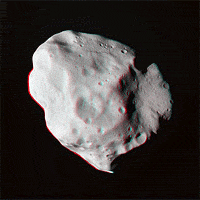
Grooves found on Lutetia, an asteroid encountered by ESA’s Rosetta spacecraft, point to the existence of a large impact crater on the unseen side of the rocky world.

Rosetta flew past Lutetia at a distance of 3168 km in July 2010, en route to its 2014 rendezvous with its target comet.

The spacecraft took images of the 100 km-wide asteroid …

Read the rest of this article

As the flight test of NASA’s Orion spacecraft nears, the agency released Wednesday a video — called “Trial By Fire” — detailing the spacecraft’s test and the critical systems engineers will evaluate during the Dec. 4 flight.

Orion is in the final stages of preparation for the uncrewed flight test that will take it 3,600 miles above Earth on a …

Read the rest of this article