NASA officials broke ground near Canberra, Australia on Wednesday, beginning a new antenna-building campaign to improve Deep Space Network communications.

Following the recommendations of an independent study, NASA embarked on an ambitious project to replace its aging fleet of 70-meter-wide (230-foot-wide) dishes with a new generation of 34-meter (112-foot) antennas by 2025.

The three 70-meter antennas, located at the NASA …

Read the rest of this article


The Discovery Channel Store is having a 2-Day Sale over Feb 23/24.

You can get $10 off $60 with Coupon Code FEB10, $15 off $75 with Coupon Code FEB15, $25 off $100 with Coupon Code FEB25.

Discovery have telescopes for all levels, from Beginners to Advanced, as well as astronomy software, eyepieces and other astronomy accessories. Plus …

Read the rest of this article

Big Sunspot Appears

The sudden emergence of big sunspot 1045 over the weekend has caused a sharp upsurge in solar activity.

The active region has produced three M-class and almost a dozen C-class solar flares since it appeared on Saturday (Feb. 6th).

The strongest blast, an M6-class eruption on Feb. 7th, may have hurled a coronal mass ejection toward Earth. High-latitude sky watchers …

Read the rest of this article

The Kepler Mission

NASA’s Kepler mission successfully launched into space from Cape Canaveral Air Force Station, Fla., aboard a United Launch Alliance Delta II at 10:49 p.m. EST, Friday. Kepler is designed to find the first Earth-size planets orbiting stars at distances where water could pool on the planet’s surface. Liquid water is believed to be essential for the formation of life.

“It …

Read the rest of this article

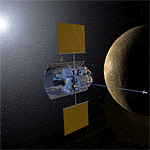
On Monday, Jan. 14, a pioneering NASA spacecraft was the first to visit Mercury in almost 33 years when it soared over the planet to explore and snap close-up images of never-before-seen terrain. These findings could open new theories and answer old questions in the study of the solar system.

The MErcury Surface, Space ENvironment, GEochemistry, and Ranging spacecraft, called …

Read the rest of this article

Jan. 26, 2010: After six years of unprecedented exploration of the Red Planet, NASA’s Mars Exploration Rover Spirit no longer will be a fully mobile robot. NASA has designated the once-roving scientific explorer a stationary science platform after efforts during the past several months to free it from a sand trap have been unsuccessful.

The venerable robot’s primary task in …

Read the rest of this article

It rises in the east at sunset, pumpkin-orange and brighter than a first magnitude star. You stare at it, unblinking. Unblinking, it stares right back.

It is Mars.

This week Earth and Mars are having a close encounter. On Jan. 27th, the Red Planet will be only 99 million kilometers away and look bigger through a telescope than at any …

Read the rest of this article

The Moon is about to pass directly in front of the sun, producing an annular solar eclipse on Jan. 15th between 05:00 and 09:00 GMT.

The zone of visibility stretches from Africa across the Indian Ocean to eastern Asia.

Onlookers in those places should be alert for crescent-shaped shadows on the ground and “ring of fire” suns in the sky.…

Read the rest of this article


An artist’s concept of an exoplanet. Image credit: ESO.

January 14, 2010: The premiere observatory of the next decade, the James Webb Space Telescope, will launch in 2014 in search of “big game”–namely, the first stars and galaxies ever formed in our Universe. But the “little game” could turn out to be just as interesting. There’s a dawning awareness among …

Read the rest of this article

A curious object is about to fly past Earth only one-third the distance to the Moon.

Cataloged as a 10m-class asteroid, 2010 AL30 has an orbital period of almost exactly 1 year. This raises the possibility that it might not be a natural object, but rather a piece of some spacecraft from our own planet.

At closest approach on Jan. …

Read the rest of this article