Earth Day 2015

July 18, 2010: NASA-funded researchers are monitoring a big event in our planet’s atmosphere. High above Earth’s surface where the atmosphere meets space, a rarefied layer of gas called “the thermosphere” recently collapsed and now is rebounding again.

“This is the biggest contraction of the thermosphere in at least 43 years,” says John Emmert of the Naval Research Lab, lead …

Read the rest of this article

AAVSO Alert Notice 422:
Observing Campaign on Hubble’s First Variable in M31: M31_V1
July 16, 2010

An observing campaign is being carried out on M31_V1, the first variable star discovered in M31 by Edwin Hubble. Dr. John Grunsfeld, Deputy Director of the Space Telescope Science Institute, plans to observe M31_V1 with the Hubble Space Telescope (HST), and needs to plan …

Read the rest of this article

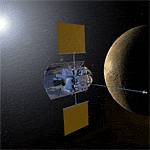
The first spacecraft designed by NASA to orbit Mercury is giving scientists a new perspective on the planet’s atmosphere and evolution.

Launched in August 2004, the Mercury Surface, Space Environment, Geochemistry and Ranging spacecraft, known as MESSENGER, conducted a third and final flyby of Mercury in September 2009. The probe completed a critical maneuver using the planet’s gravity to remain …

Read the rest of this article

Asteroid Lutetia has been revealed as a battered world of many craters. ESA’s Rosetta mission has returned the first close-up images of the asteroid showing it is most probably a primitive survivor from the violent birth of the Solar System.

The flyby was a spectacular success with Rosetta performing faultlessly. Closest approach took place at 18:10 CEST on July 10th, …

Read the rest of this article

It’s every vacationer’s dream: You stretch out on a white sandy beach for a luxurious nap under the South Pacific sun. The caw of distant gulls wafts across the warm sea breeze while palm fronds rustle gently overhead. You take it all in through half-closed eyes.

Could Paradise get any better? This weekend it will.

On Sunday, July 11th, the …

Read the rest of this article

NASA successfully launched the Lunar Crater Observation and Sensing Satellite, or LCROSS, Thursday on a mission to search for water ice in a permanently shadowed crater at the moon’s south pole. The satellite lifted off on an Atlas V rocket from Cape Canaveral Air Force Station, Fla., at 5:32 p.m. EDT, with a companion mission, the Lunar Reconnaissance Orbiter, or …

Read the rest of this article


An artist’s concept of New Horizons.

Zipping through space at nearly a million miles per day, NASA’s New Horizons probe is halfway to Pluto and just woke up for the first time in months to look around.

“Our spacecraft is way out in exotic territory, in the middle of nowhere,” says Hal Weaver, New Horizons project scientist at Johns Hopkins …

Read the rest of this article


Mariner 9 image of the north polar cap of Mars. The image was taken on 12 October 1972, about one-half Martian month after summer solstice, at which time the cap had reached its minimal extent. The cap is about 1000 km across. The interior dark markings are frost-free sun-facing slopes. A smooth layered sedimentary deposit underlies the cap. The image

Read the rest of this article

Detailed observations made by NASA’s Hubble Space Telescope have found an answer to the flash of light seen June 3 on Jupiter. It came from a giant meteor burning up high above Jupiter’s cloud tops. The space visitor did not plunge deep enough into the atmosphere to explode and leave behind any telltale cloud of debris, as seen in previous …

Read the rest of this article

NASA’s Kepler Mission has released 43 days of science data on more than 156,000 stars. These stars are being monitored for subtle brightness changes as part of an ongoing search for Earth-like planets outside of our solar system.

Astronomers will use the new data to determine if orbiting planets are responsible for brightness variations in several hundred stars. These stars …

Read the rest of this article