NASA’s Dawn spacecraft on Saturday became the first probe ever to enter orbit around an object in the main asteroid belt between Mars and Jupiter.

Dawn will study the asteroid, named Vesta, for a year before departing for a second destination, a dwarf planet named Ceres, in July 2012. Observations will provide unprecedented data to help scientists understand the earliest …

Read the rest of this article

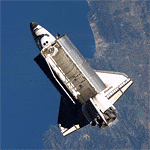
The STS-135 crew of space shuttle Atlantis and the Expedition 28 crew of the International Space Station have been treated with great views of the Aurora Australis.

Here’s one shot the crews photographed, showing a panoramic view of the station/shuttle complex along with several different astronomical beauties! The aurora shows up brightly, but what else is in the image? Looking …

Read the rest of this article

NASA’s Dawn spacecraft will begin a prolonged encounter with the asteroid Vesta today (July 15), making the mission the first to enter orbit around a main-belt asteroid.

The main asteroid belt lies between the orbits of Mars and Jupiter. Dawn will study Vesta for one year, and observations will help scientists understand the earliest chapter of our solar system’s history.…

Read the rest of this article

This bit of info was sent to me by John Flannery who runs the South Dublin Astronomical Society (SDAS):

“Check out this documentary about space science in the Republic of Ireland on Youtube – I’m in it but had no hand in its production. It was made in 2007, just released this week [Ed: this was mid-June], and is a …

Read the rest of this article

Do you know what today is? It’s the day on which Neptune has finally completed one full orbit of the sun, since its discovery in 1846. One orbit in just under 165 years.


This fascinating video (courtesy NASA, ESA, and G. Bacon and M. Estacion (STScI)) puts that one Neptunian orbit into an Earth timeline perspective

Neptune is a giant …

Read the rest of this article

AAVSO Alert Notice 443
Long-term monitoring of four AGN in support of ground-based spectroscopy
July 8, 2011

Dr. Misty Bentz of Georgia State University requests observations of four active galactic nuclei (AGN) for a study of variability in these sources by the STARE Collaboration. She requests BVRcIc filtered photometry of NGC 6814, NGC 7213, NGC 7469, and NGC 1566 from …

Read the rest of this article

Space shuttle Commander Chris Ferguson and his three crewmates are on their way to the International Space Station after launching from NASA’s Kennedy Space Center at 11:29 a.m. EDT Friday. STS-135 is the final mission of NASA’s Space Shuttle Program that will end the multi-purpose spaceplane programme’s three-decade era of human spaceflight.


On 8 July 2011, Space Shuttle Atlantis lifted …

Read the rest of this article

The largest digital camera ever built for a space mission has been painstakingly mosaicked together from 106 separate electronic detectors. The resulting “billion-pixel array” will serve as the super-sensitive ‘eye’ of ESA’s Galaxy-mapping Gaia mission.


A total of 106 CCDs make up Gaia’s focal plane. Technicians from Astrium France, the Gaia mission’s prime contractor, are seen bolting and aligning the …

Read the rest of this article

NASA’s Hubble Space Telescope crossed another milestone in its space odyssey of exploration and discovery. On Monday, July 4, the Earth-orbiting observatory logged its one millionth science observation during a search for water in an exoplanet’s atmosphere 1,000 light-years away.

“For 21 years Hubble has been the premier space science observatory, astounding us with deeply beautiful imagery and enabling ground-breaking …

Read the rest of this article

A bubble-like burst of light captured on two Hawaii telescopes last week likely has a terrestrial origin, observers say. What looks like a giant bubble rising and expanding in space in this video taken on 22 June from Hawaii is actually just exhaust from a missile launch.

Atmospheric flare from a minuteman III ICBM missile

Astronomer Phil Plait brought the …

Read the rest of this article