|
|
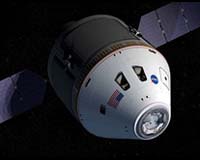
NASA has established a requirements baseline for the Orion crew exploration vehicle, bringing America’s next human spacecraft a step closer to construction.
The Orion Project completed its system requirements review in cooperation with its prime contractor, Lockheed Martin, March 1. The review marked the first major milestone in the Orion engineering process and provided the foundation for design, development, construction and safe operation of the spacecraft that will carry explorers to Earth orbit, to the moon, and eventually to Mars. The detailed requirements established in this review will serve as the basis for ongoing design analysis work and systems testing.
“This is a significant step in the development of a space transportation system that will expand our horizons to include other worlds,” said Skip Hatfield, Orion Project manager at NASA’s Johnson Space Center in Houston.
The Orion review followed an overall review of requirements for the Constellation Program that was completed in November. Similar reviews are planned later this spring for ground and mission operations systems that will support Constellation launch systems and space flight operations ground infrastructure.
“We have now completed program-wide launch vehicle and human spacecraft system requirements reviews,” said Constellation Program Manager Jeff Hanley. “These are important pieces of a management and engineering puzzle that will allow us to accomplish the goal of putting humans back on the moon.”
The Orion requirements data set was reviewed by agency and contractor scientists and engineers from across the country. More than 1,700 topics covering all aspects of vehicle performance, design and qualification were discussed during the course of the formal review.
Once all project-level reviews are complete, the Constellation Program will hold another full review to update baseline requirements. A lunar architecture systems review of equipment associated with surface exploration and science activities on the moon is expected in the spring of 2009.
For more information about NASA’s Constellation Program, visit: http://www.nasa.gov/constellation
[phpbay](NASA Orion Spacecraft|nasa), 100, “1”, “”[/phpbay]
[phpbay]””, 100, “74927”, “”[/phpbay]
[phpbay]””, 100, “74922”, “”[/phpbay]
NASA Orion Spacecraft Videos:
[tubepress mode=”tag” tagValue=”NASA Orion Spacecraft”]
Amazon.com BestSellers
| [phpzon keywords=”space program” searchindex=”Books” num=”3″] |


I strongly agree that on orbit fuel depots make a lot of sense. I’d add a couple reasons:Increasing flight rates for smaller fuel tankers, would drive down cost per pound by amortorizing overhead over a greater number of flights.Increased effective performance of RLVs. Refuel a DC-X like RLV in orbit and it can then fly to any Earth orbit, lunar surface and back, or to Mars. More mundane, a RLV that can only just get to a low useless orbit, could refuel at a depot parked there (or a tanker sister craft) and boost to any other desired orbit. Making designing said RLV a lot easier.And just to play devils advocate.Most stacked launch vehicles can’t take launch stresses on empty tanks, and the bulk of such tanks (even if empty or loaded with presurent) would drive you to a larger launch vehicle – even with lighter cargo. You could wind up with similar launch costs since you have to use the big expensive bird either way.> Adaptability: Propellant transfer and storage technologies (especially> in the form of propellant depots) allow a space transportation system > to take advantage of improvements in launch vehicles over time. > By separating the launcher from the interorbital transfer stages, > landers, and other in-space hardware, it makes it a lot easier to > take advantage of upgrades over time. I’m not sure this really relates to on orbit refueling as much as multiple launches per cargo. Say as a argument for on orbit (hopefully reusable) inter-orbital tugs. Obviously you need to launch your tran stages from Earth eiather way. So taking advantage of new upper stages by integrating them onto a existing multi stage LV, works as well with or without on-orbit refueling. The same way you reintegrate new parts to your PC, rather then separate its function into separate processor blocks you transfer the data between by hand.;)> Dependability: In a world of expendable launchers, where launcher > reliability is still depressingly low, a propellant depot serves as a buffer> or capacitor between a lunar or martian mission, and the launch > vehicles that put the components up. A commercial propellant depot> can buy from whoever can launch to it, and with the likely propellant > demands for even modest lunar transportation architectures, it will be> buying from lots of suppliers. If one launcher starts having problems,> the show still goes on. ==A counter argument is since you still need to launch the cargo either way – you have a equal exposure to being grounded. If you launch everything at ones. If it makes it your clear. If not – your not. If you launch it in parts (fuel on some flights, systems on others, upper-stages somewhere else) any single systems launch failure grounds you. You in theory can absorb fuel launch failures by having the fuel launched by other launch services – but how long before their will be enough demand for such services to keep multiples in business?So statistically, how much more likely would you be to get a successful mission?
I was sure that the gap in launch capabilities for the United States was created when the decision to retire the shuttle in 2010 was made. It was proposed by Ex President Bush, in VSE (Vision for Space Exploration), which came out in 2004, that a new CEV (crew exploration vehicle) come online by 2014.
Oler’s musing on manned space flight operations are nulled by his own words: “Robert G. Oler wrote September 2nd, 2010 at 4:17 pm “First I really dont care that we (the US or humanity or whatever) goes to the Moon or Mars or an asteroid in the next 10-20 years. I dont think that there is any need to send people we have good robotics which can do the job at far lower cost.” ‘Nuff said.