Amateur astronomer Anthony Wesley from Canberra, Australia captured an image of Jupiter on July 19, 2009 showing a possible new impact site. Anthony’s image shows a new dark spot in the South Polar Region of Jupiter, at approximately 216° longitude in System 2. It looks very similar to the impact marks made on Jupiter when comet Shoemaker-Levy 9 crashed into the gas giant in 1994.
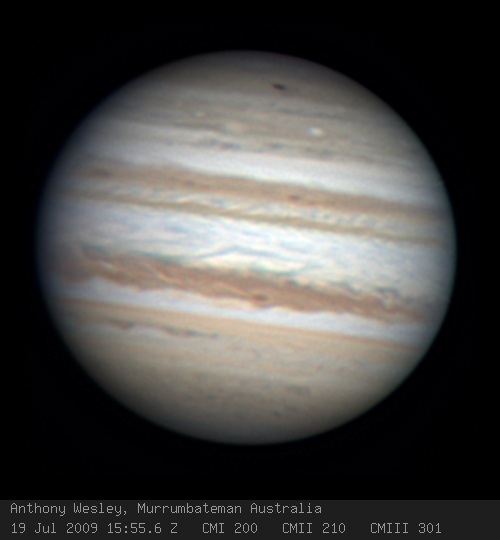
The dark impact mark first noted at approximately 13:30 UTC on 19th July 2009 from his home observatory just outside Murrumbateman, NSW, Australia.
While there was some thought that this might be a local weather feature, Glenn Orton from JPL has since imaged the area using the NASA Infrared Telescope on Hawaii, and confirmed that it is indeed an impact site and not a localised weather event.
Anthony started this imaging session on Jupiter at approximately 11pm local time (13:00 UTC). The weather prediction was not promising – clear skies but a strong jetstream overhead according to the Bureau or Met. The temperature was also unusually high for this time of year (winter), also a bad sign.
The scope in use was a new 14.5″ newtonian, in use now for a few weeks and so far returning excellent images.
He was pleasantly surprised to find reasonable imaging conditions and so decided to continue recording data until about 1am local time. By 1am he was ready to quit, and indeed had hovered the mouse over the exit button on his image capture application (Coriander for Linux). Changing his mind, he decided to carry on for another half hour or so.
He’d noticed a dark spot rotating into view in Jupiter’s south polar region and was starting to get curious. When first seen close to the limb (and in poor conditions) it was only a vaguely dark spot, likely to be just a normal dark polar storm. However, as it rotated further into view, and the conditions also improved, Anthony suddenly realised that it wasn’t just dark, it was black in all channels, meaning it was truly a black spot.
His next thought was that it must be either a dark moon (like Callisto) or a moon shadow, but it was in the wrong place and the wrong size. He’d also noticed that it was moving too slow to be a moon or shadow. It appeared to be rotating in sync with a nearby white oval storm that he was very familiar with – this could only mean that the back feature was at the cloud level and not a projected shadow from a moon.
It took another 15 minutes to really believe that he was seeing something new – he’d imaged that exact region only 2 days earlier and checking back to that image showed no sign of any anomalous black spot.
Now caught between a rock and a hard place – Anthony wanted to keep imaging but also I was aware of the importance of alerting others to this new event. In the end he imaged for another 30 minutes only because the conditions were slowly improving and each capture was giving a slightly better image than the last.
Eventually he stopped imaging and returned to the house to start emailing people, with the image above processed as quick and dirty as possible just to have something to show.
More images will be taken by Anthony and many other people in the next few days. You’ll find them here: http://jupiter.samba.org/jupiter-impact.html

| More Information | |||||
|
Jupiter – “SolarViews” Jupiter page. Jupiter – “Nine Planets” Jupiter page. Comet Shoemaker-Levy 9 Collision With Jupiter – Images and movies of the collision of the comet with Jupiter in 1994. Jupiter Impact movies (1994) Countdown to Jupiter Impact – Images and animations from the Galileo mission to Jupiter. Galileo Mission Legacy Site Galileo Mission Home Page Juno Mission – Juno is a new mission scheduled for launch in August 2011. Europa/Jupiter Mission – A proposed future mission to visit Jupiter and Europa. LunarPhase Pro – learn more about Jupiter and its four main satellites with this software for Windows PCs. |
|||||
[phpbay](planet jupiter), 100, “378”, “”[/phpbay]
Planet Jupiter Videos:
[tubepress mode=”tag” tagValue=”astronomy jupiter”]
Amazon.com BestSellers
| [phpzon keywords=”planet jupiter” searchindex=”Books” num=”3″] |
Filed under: Jupiter