I recently received an email about a movie of the Venus transit that had been recorded down in Crete. The video was shot with a 6″ Maksutov f/12 telescope and a Canon D40 dSLR in South Crete at the Sasteria public observatory:
Astronomers around the world looked to the sky on the night of June 5th and morning of June 6th to observe Venus as it passed across the face of the Sun for the last time this century. ESA’s Sun-watching space missions also tuned in for the solar spectacular.
ESA’s Proba-2 microsatellite, in low-Earth orbit, tracked Venus across the solar disc … Read the rest of this article
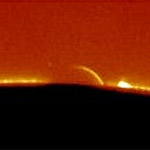
When Venus transited the sun on June 5th and 6th, an armada of spacecraft and ground-based telescopes were on the lookout for something elusive and, until recently, unexpected: The Arc of Venus.
“I was flabbergasted when I first saw it during the 2004 transit,” recalls astronomy professor Jay Pasachoff of Williams College. “A bright, glowing rim appeared around the edge … Read the rest of this article
Scientists and amateur astronomers around the world are preparing to observe the rare occurrence of Venus crossing the face of the Sun on 5-6 June, an event that will not be seen again for over a hundred years.
Read the rest of this article
On June 8, 2004, the planet Venus passed across the disk of the Sun in a rare transit. The last such transit …
This week Venus, the second planet from the sun, will pass directly in front of the Pleiades star cluster. It’s a rare sunset conjunction that’s easy to find with the unaided eye, but best seen through binoculars or a small telescope.
Venus approaching the Pleiades on March 31st, photographed by astronomy professor Jimmy Westlake of Stagecoach, Colorado.
The action begins … Read the rest of this article
ESA’s Venus Express spacecraft has discovered that our cloud-covered neighbour spins a little slower than previously measured. Peering through the dense atmosphere in the infrared, the orbiter found surface features were not quite where they should be.
Venus Express in orbit since 2006 around our nearest planetary neighbour. Credits: ESA
Using the VIRTIS instrument at infrared wavelengths to penetrate the … Read the rest of this article
T’was the Night after Christmas and all through the house, not a creature was stirring …
…because everyone was outside watching the planets align?
It’s true. On Dec. 26th, the night after Christmas, Venus and the slender crescent Moon will gather for a jaw-dropping conjunction in the western sky.
The action begins shortly before sunset. Around 4:30 pm to 5:00 … Read the rest of this article
Nearly 130 years ago , the premier event in astrophysics involved watching a tiny dot slowly sail across the surface of the sun. That dot was our sister planet, Venus, and observing its transit as it passed directly between the Earth and sun was a momentous scientific undertaking.
Read the rest of this article
This image comes from 1882, when astronomers were very keen to make …
A mysterious high-altitude layer of sulphur dioxide discovered by ESA’s Venus Express has been explained. As well as telling us more about Venus, it could be a warning against injecting our atmosphere with sulphur droplets to mitigate climate change.
|
Close-up on venusian cloud structures at the south pole |
Venus is blanketed in sulphuric acid clouds that block our view of … Read the rest of this article
Venus Express has completed an ‘aerodrag’ campaign that used its solar wings as sails to catch faint wisps of the planet’s atmosphere. The test used the orbiter as an exquisitely accurate sensor to measure atmospheric density barely 180 km above the hot planet.
During five aerodrag measurements last week, Venus Express’ solar arrays and control systems were operated as one … Read the rest of this article