Curiosity Mars Rover

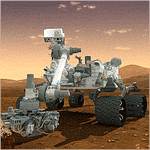
The scientists and engineers of NASA’s Curiosity rover mission have selected the first driving destination for their one-ton, six-wheeled mobile Mars laboratory. The target area, named Glenelg, is a natural intersection of three kinds of terrain. The choice was described by Curiosity Project Scientist John Grotzinger of the California Institute of Technology during a media teleconference on Aug. 17.


This …

Read the rest of this article

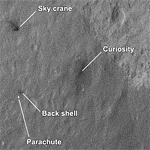
The first color image taken from orbit showing NASA’s rover Curiosity on Mars includes details of the layered bedrock on the floor of Gale Crater that the rover is beginning to investigate.


This color-enhanced view (click image for larger view) of NASA’s Curiosity rover on the surface of Mars was taken by the High Resolution Imaging Science Experiment (HiRISE) on …

Read the rest of this article

Curiosity Mars Rover

The first images from Curiosity’s color Mast Camera, or Mastcam, have been received by scientists at NASA’s Jet Propulsion Laboratory in Pasadena, Calif. The 130 low-resolution thumbnails, which were received Thursday morning, provide scientists and engineers of NASA’s newest Mars rover their first color, horizon-to-horizon glimpse of Gale Crater.


This is the first 360-degree panorama in color of the Gale …

Read the rest of this article

Curiosity Mars Rover

Remarkable image sets from NASA’s Curiosity rover and Mars Reconnaissance Orbiter are continuing to develop the story of Curiosity’s landing and first days on Mars.


Curiosity Takes It All In: This is the first 360-degree panoramic view from NASA’s Curiosity rover, taken with the Navigation cameras (click image for larger view). Most of the tiles are thumbnails, or small copies …

Read the rest of this article

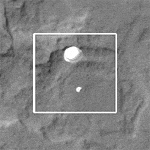
Late Monday night, an image from the High Resolution Imaging Science Experiment (HiRISE) camera aboard NASA’s Mars Reconnaissance Orbiter captured the Curiosity rover and the components that helped it survive its seven-minute ordeal from space to its present location in Mars’ Gale Crater.

“This latest image is another demonstration of the invaluable assistance the Mars Reconnaissance Orbiter team, and its …

Read the rest of this article

The Curiosity Mars Descent Imager (MARDI) captured the rover’s descent to the surface of the Red Planet. The instrument shot 4 fps video from heatshield separation to the ground. This stop-motion video shows 297 frames from the Mars Descent Imager aboard NASA’s Curiosity rover as it descended to the surface of Mars. These thumbnail images were received on Earth on …

Read the rest of this article

Relive the nail-biting terror and joy as NASA’s Curiosity rover successfully landed on Mars the evening of Aug. 5 PDT (morning of Aug. 6 EDT). See and hear the team inside JPL mission control along with a visualization of the spacecraft’s entry, descent and landing.

[phpbay keywords=”(planet mars*), (mars rover*), (mars meteor*)” num=”99″ category=”1 267 11232 3239″ sortorder=”EndTimeSoonest” templatename=”columns” columns=”3″ …

Read the rest of this article

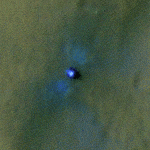
An image from the High Resolution Imaging Science Experiment (HiRISE) camera aboard NASA’s Mars Reconnaissance Orbiter captured the Curiosity rover still connected to its 51-foot-wide (almost 16 meter) parachute as it descended towards its landing site at Gale Crater.


NASA’s Curiosity rover and its parachute were spotted by NASA’s Mars Reconnaissance Orbiter as Curiosity descended to the surface on Aug. …

Read the rest of this article

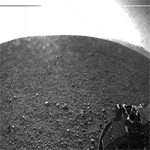
About two hours after landing on Mars and beaming back its first image, NASA’s Curiosity rover transmitted a higher-resolution image of its new Martian home, Gale Crater. Mission Control at NASA’s Jet Propulsion Laboratory in Pasadena, Calif., received the image, taken by one of the vehicle’s lower-fidelity, black-and-white Hazard Avoidance Cameras – or Hazcams.


The black-and-white, 512 by 512 pixel …

Read the rest of this article

This morning at 7:14 CEST (Central European Summer Time), ESA’s Mars Express acquired signals from NASA’s Mars Science Laboratory as it delivered the car-sized Curiosity rover onto the Red planet’s surface. ESA’s New Norcia tracking station also picked up signals directly from the NASA mission, 248 million km away at Mars.


A Celestia animation based on forecast orbital trajectories of …

Read the rest of this article