Often, comets are portrayed as harbingers of gloom and doom in movies and on television, but most pose no threat to Earth. Comet Elenin, the latest comet to visit our inner solar system, is no exception. Elenin will pass about 22 million miles (35 million kilometers) from Earth during its closest approach on Oct. 16, 2011.


Trajectory of comet Elenin. …

Read the rest of this article

Comet Elenin is coming to the inner-solar system this fall/autumn. Comet Elenin (also known by its astronomical name C/2010 X1), was first detected on Dec. 10, 2010 by Leonid Elenin, an observer in Lyubertsy, Russia, who made the discovery “remotely” using the ISON-NM observatory near Mayhill, New Mexico. At the time of the discovery, the comet was about 647 million …

Read the rest of this article


Artist’s impression of the Rosetta orbiter and lander

On 8 June, mission controllers had the first opportunity to switch ESA’s Rosetta comet-hunter into deep-space hibernation for 31 months. During this loneliest leg of its decade-long mission, Rosetta will loop ever closer toward comet 67-P, soaring to almost 1000 million km from Earth.

Marking one of the most dramatic and distant …

Read the rest of this article

Comet Halley’s nucleus as seen by Giotto

Twenty-five years ago, ESA made its mark in deep space. A small spacecraft swept to within 600 km of Halley’s comet. The Giotto probe was nearly destroyed by the encounter but what it saw changed our picture of comets forever.

As debuts go, it doesn’t get any better than Giotto. The spacecraft was …

Read the rest of this article

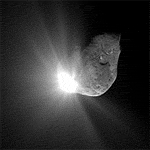
NASA’s Stardust spacecraft returned new images of a comet showing a scar resulting from the 2005 Deep Impact mission. The images also showed the comet has a fragile and weak nucleus.

The spacecraft made its closest approach to comet Tempel 1 on Monday, Feb. 14, at 8:40 p.m. PST (11:40 p.m. EST) at a distance of approximately 178 kilometers (111 …

Read the rest of this article

Mission controllers at NASA’s Jet Propulsion Laboratory, Pasadena, Calif., watched as data downlinked from the Stardust spacecraft indicated it completed its closest approach with comet Tempel 1. An hour after closest approach, the spacecraft turned to point its large, high-gain antenna at Earth. It is expected that images of the comet’s nucleus collected during the flyby will be received on …

Read the rest of this article

NASA is about to discover how solar heat devours a comet.


Stardust-NExT chases a comet, an artist’s concept. [more]

“For the first time, we’ll see the same comet before and after its closest approach to the sun,” explains Joe Veverka, principal investigator for NASA’s Stardust-NExT mission.

The comet is Tempel 1, which NASA’s Deep Impact probe visited in …

Read the rest of this article

The sun has just experienced a storm—not of explosive flares and hot plasma, but of icy comets.

“The storm began on Dec 13th and ended on the 22nd,” says Karl Battams of the Naval Research Lab in Washington, DC. “During that time, the Solar and Heliospheric Observatory (SOHO) detected 25 comets diving into the sun. It was crazy!”

Sundiving comets—a.k.a. …

Read the rest of this article

NASA’s EPOXI mission spacecraft successfully flew past comet Hartley 2 at 10 a.m. EDT Thursday. Scientists say initial images from the flyby provide new information about the comet’s volume and material spewing from its surface.

The following is a statement from NASA Administrator Charles Bolden on the EPOXI mission’s successful flyby of comet Hartley 2:

“NASA extended its pioneering exploration …

Read the rest of this article

NASA’s Deep Impact (EPOXI) probe is closing in on Comet Hartley 2 for a daring flyby today (Nov. 4th).

The small but active comet is full of surprises, with spinning jets, geysers of cyanide gas, and a strangely pickle-shaped core. Mission scientists expect to reveal first images from the flyby during a press conference on Thursday afternoon, around 4 pm …

Read the rest of this article