“In the Shadow of the Moon” DVD Review
In the Shadow of the Moon (DVD/HD-DVD/Blu-Ray)
Starring: Colonel Buzz Aldrin, USAF, R, Captain Alan Bean, USN, R, Captain Eugene Cernan, USN, R, Brig. Gen. Michael Collins, USAF, R, Brig. Gen. Charles Duke, USAF
Update, June 2009: In the Shadow of the Moon is now available on Blu-Ray in the United Kingdom


Now, nearly 20 years later, we finally have a worthy successor in David Sington’s “In the Shadow of the Moon.” You might think you already know everything you need to know about the Apollo space program that galvanized America in the 1960s. But this remarkable documentary proves you wrong.
Where the For All Mankind
It’s funny to think how much the ’60s, in hindsight, seems a relatively low-tech era: no cable, no Internet, no videogames, no mobile phones, no iPod. The space program, more than anything, helped to lay the groundwork for the age we’re now in, and In the Shadow of the Moon
A large failing of For All Mankind
But getting off the Earth was just the beginning. The astronauts take us on a journey as they cross cislunar space, drop down onto that forbidding surface, conduct scientific experiments that have laid the foundation for our present understanding of our place in the universe, then blast off the moon to return to Earth. Yet even then, the journey is just beginning.
At least astronaut from each Apollo lunar mission speaks about their thoughts and feelings about their apocryphal experiences. These are not glossed-over propaganda statements, but heart-felt and honest reminiscences from these men, giving us insights that have never before been the subject of a space documentary.
Not only do we get to see Apollo footage as it has never been seen, and to hear the astronauts express themselves as never before, but they have gone one step further by marrying the sound and film from Mission Control. We are all so familiar with the words spoken by Neil Armstrong as he stepped onto the dusty lunar surface, and the voice from Mission Control that answers him (it was actually Charlie Duke), so it may come as a surprise that all film footage inside Mission Control was silent. The producers found the audio loops and painstakingly matched the voices to film for the first time ever. This is a memorable feat that may go unnoticed by many viewers, but from a historical perspective, it is a welcome show of the filmmaker’s diligence with “In the Shadow of the Moon.”
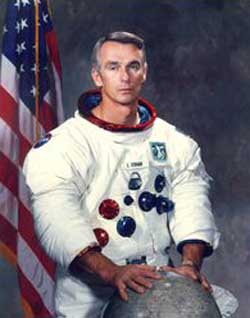 Gene Cernan spoke of going “into darkness after being in daylight the whole time – and we’re in the shadow of the moon.”
Cernan’s comment provided the title of his movie, and it is a perfect one. Cernan has proven himself one of the most eloquent writers and speakers on his experiences. He talks about what he thought when he heard President Kennedy commit America to a moon landing in less than a decade: “He challenged us to do what I think most people thought was impossible, including me.”
And yet, Cernan saw the dream Kennedy presented to the USA in that heady dsecade and hopped aboard for several memorable flights, including as commander of the last Apollo flight to touch down on the moon, Apollo 17.
Jim Lovell is now most famous for being the commander of the ill-fated Apollo 13, but few remember he was also aboard the first flight beyond the confines of the Earth – Apollo 8 – which sailed over the Moon in 1968. “Just from the distance of the moon, you can hide the Earth behind your thumb, everything that you have ever known; your loved ones, your business, the problems of the Earth itself, all behind your thumb. It makes you consider how insignificant we really are.”, he says.
Some of the more interesting comments come from an astronaut who never actually walked on the surface of the moon, Apollo 11 Command Module pilot, Michael Collins: “To me, the marvel of it is that it all worked like clockwork, I almost said ‘like magic.’ There might be a little magic mixed up in that big clock somewhere, because everything worked as it was supposed to. Nobody messed up. Even I didn’t make mistakes. I have a lot of things I can do wrong, but the consequences, should I do them wrong, are going to be immediately obvious to three billion people.” (Yes, the population of Earth in 1969 was just half of what it is today!)
I was a kid when the manned space program was beginning. And I remember us kids playing out on the road and being called in to the nearest house to watch the latest rocket launch. It was a big deal back then, exciting and enthralling. An then in the wee, small hours of a memorable morning (European time), watching in awe, as did most of the world, as first man hesitantly put his foot on another world. Those born afterwards have had nothing of comparison in their lives. Moon landings are a few pages in the history books for them (if they even believe they happened); they never were able to register the gut feeling of watching this happen in real time so many decades ago. With “In the Shadow of the Moon,” everyone alive today will get at least some of the feelings those of us of the Apollo generation got to feel first hand.
What better way to inspire the new generation for our return to the moon and subsequent expansion into the cosmos than by giving them a shot of adrenaline from the pioneers who first took us there?
Six-time astronaut and Apollo 16 moonwalker, John Young puts some of this in perspective when he discusses his view from space. “There’s a lot of things like urban pollution, and you can see that when you hit orbit now. You can see that big cities all have their own set of unique atmospheres. We ought to be looking out for our kids and our grandkids. [Instead] what are we worried about? The price of a gallon of gasoline.”
Seeing our Earth from space, then moving beyond that, is one of the best ways to understand our home planet and to make it safe for future generations. After all, it was the views from space in the 1960s and early 1970s that launched the environmental movement. Without Apollo, would we have the global perspective we enjoy today? Only when you can block out an entire world of billions of people with your thumb, as Jim Lovell said, can we truly see what we have to deal with.
[amzn_product_inline asin=’B000XJ5TPE’]Overall, however, the real virtue of In the Shadow of the Moon” is its reminder that basically we have no interest in the space race today. The program is plagued with technical problems, flights are more regularly cancelled than completed, and our collective interest in space flight now falls somewhere between the attendance of Transformers on its eighth week in theaters and that fifth story on the Yahoo news roundup, below the one about the letter from Davy Crockett that sold for some unimaginable amount on eBay. Our obsession with celebrity “culture,” not to mention our increasing fascination with tabloid-style headlines about normal folks’ personal woes, occupies so much space on the news landscape (much less our hearts and minds) it seems little wonder that we’re no longer looking to the stars.
Further testament to this is the fact that even our movies — that barometer for our interests, measured in box office receipts — have turned inward, exploring extraterrestrial influences only insofar as they affect us (see: Transformers, Rise of the Silver Surfer). The fantastic hardly seems so now because we’re too busy paying attention to Lindsay Lohan’s underwear (or more accurately lack thereof). But In the Shadow of the Moon
Sington may have created a film which to the casual viewer feels as if we’ve seen and done it all before, cinematically speaking. But as far as real life and real possibilities are concerned, In the Shadow of the Moon
In the Shadow of the Moon
Note: In the Shadow of the Moon
“In the Shadow of the Moon” Trailer
Other Recommended Movies
In The Shadow of The Moon Videos:
[tubepress mode=”tag” tagValue=”apollo 11 astronaut moon landing” orderBy=”relevance”]


What an exciting time for the United States space program! The Gemini missions, often overshadowed by the pioneering Mercury program, and the achivements of the Apollo program, were, in my opinion, the most exciting because of the number of “firsts” (first US multi-man mission, spacewalk, change in orbit, rondezvous, docking, etc., etc.,), and the most productive 18 months of the entire space program. These missions provided the training and experience our astronauts needed to get to the moon. To this day, I am in awe.
Bill Linsao
A lot of people think that we were running out of time with the Moon program and they didn't want the Russians to beat us so they faked the first one. I really get irritated when people talk about fake Moon landings. Such a secret would have been impossible to keep all these years. It would have been easier to just to go ahead and go rather than to try to pull that off. To me the best answer is the laser reflector that still sits on the Sea of Tranquility and the scientists that regularly use it to measure the distance from the Earth to the Moon.
Speaking of FROM THE EARTH TO THE MOON, I'm watching it right now on DVD. What an excellent series that was. We all owe Tom Hanks a debt of gratitude for that. It would make any American who lives through the era swell with pride for what we accomplished.
I'm looking forward to seeing IN THE SHADOW OF THE MOON.
Eric
.
I met Captain Eugene Cernan, the last man on the moon (Apollo 17) at a dinner/speech during the dedication of the Hruska wing of the Czech & Solvak Museum. Captain Cernan is of Czech decent.
Possibly. That is a good argument but a lot of people think that we were running out of time and they didn't want the Russians to beat us so they faked the first one. I really get irritated when people talk about fake Moon landings. Such a secret would have been impossible to keep all these years. It would have been easier to just to go ahead and go rather than to try to pull that off. To me the best answer is the laser reflector that still sits on the Sea of Tranquility and the scientist that regularly use it to measure the distance from the Earth to the Moon.
Speaking of FROM THE EARTH TO THE MOON, I'm watching it right now on DVD. What an excellent series that was. We all owe Tom Hanks a debt of gratitude for that. It would make any American who lives through the era swell with pride for what we accomplished.
I’m looking forward to seeing IN THE SHADOW OF THE MOON.
Eric