This is a great time to be observing the planet Jupiter. It’s nearing opposition; it big and bright in the late-night/early-morning sky and that can only mean that lots of astronomers are pointing telescopes and cameras at it.
And that scrutiny aid off yesterday morning (about 6:35 am Texas time – 11:35 UT – on Sept. 10, 2012) when two amateur astronomers witnessed a flash on Jupiter. The resulting fireball was witnessed by a handful of observers and George Hall in Dallas, Texas captured a flash from the impact on a webcam movie (see http://georgeastro.weebly.com/jupiter.html )
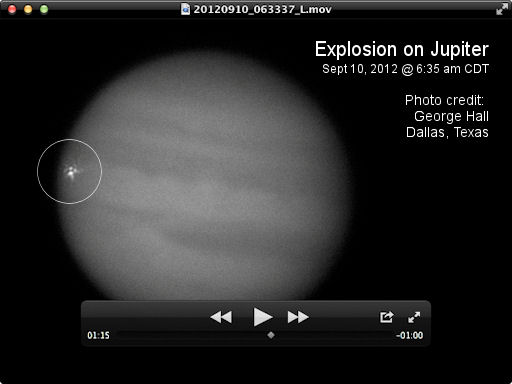
Impact site coordinates: longitude 335 degrees (system 1) and latitude +12 degrees, inside the North Equatorial Belt’s southern section.
Amateur astronomer Dan Peterson Racine, in Wisconsin, also saw it first through his Meade 12″ LX200 telescope. “It was a bright white flash that lasted only 1.5 – 2 seconds,” he reported.
“I was thinking about imaging Jupiter this morning but decided to observe it instead,” Petersen notes in a post to CloudyNights.com. “Had I been imaging I’m sure I would have missed it between adjusting webcam settings and focusing each avi .”
Petersen’s report quickly reached the Association of Lunar and Planetary Observers and the British Astronomical Association, and from there it went out to a network of professional observers.
The fireball was probably caused by a small asteroid or comet hitting Jupiter. Similar impacts were observed in June and August 2010. An analysis of those earlier events suggests that Jupiter is frequently struck by 10 meter-sized asteroids – one of the hazards of orbiting near the asteroid belt and having such a strong gravitational pull.
Jupiter’s midsection spins every 9 hours 50.5 minutes — slightly faster than the rotation rates of regions well away from the equator (referred to as System II) or the planet’s interior (System III). This would have put the impact’s location roughly centered on the disk on September 10th at 23:00 UT. You can look again on the 11th (today) at around 8:45 UT (favoring western North America) and again at 19:00 UT (eastern Europe and western Asia).
The first time something was seen to slam into Jupiter was when Voyager 1 recorded a fireball as it flew past in 1979. The most well-known impact was when fragments of the Comet Shoemaker-Levy 9 comet impacted in 1994 (the comet was torn apart by Jupiter’s gravity). “Even if this flash ends up being ‘just a meteor’,” Franck Marchis (SETI Institute) writes in his blog about the event, “it is remarkable that amateur astronomers are today capable of monitoring almost permanently the planet Jupiter.”
Observers worldwide are being urged to view the planet over the next few days to see if any impact scars develop.
Jupiter is in Taurus at the moment where it is the brightest star-like object in this region of the sky and shines at magnitude -2.2.
Stay tuned for news about what happens next.
Filed under: Astronomy News • Jupiter