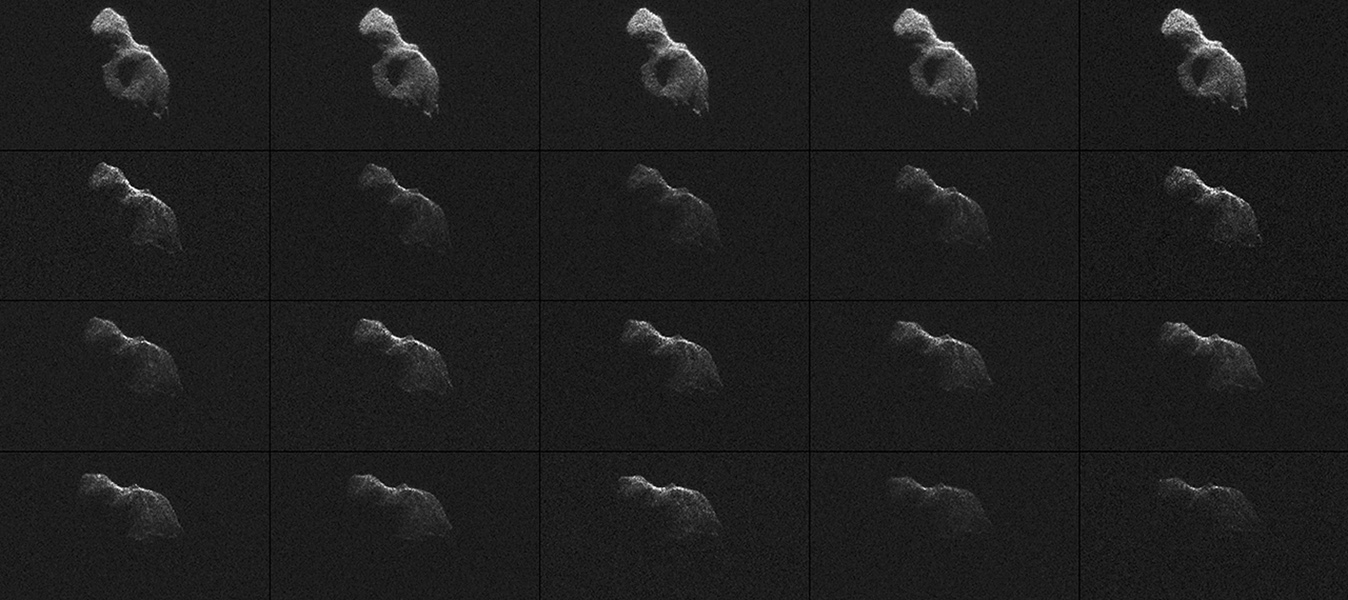
NASA scientists using Earth-based radar have produced sharp views of a recently discovered asteroid as it slid silently past our planet. Captured on June 8, 2014, the new views of the object designated “2014 HQ124” are some of the most detailed radar images of a near-Earth asteroid ever obtained.
An animation of the rotating asteroid and a collage of the images are here.
The radar observations were led by scientists Marina Brozovic and Lance Benner of NASA’s Jet Propulsion Laboratory, Pasadena, California. The JPL researchers worked closely with Michael Nolan, Patrick Taylor, Ellen Howell and Alessondra Springmann at Arecibo Observatory in Puerto Rico to plan and execute the observations.
According to Benner, 2014 HQ124 appears to be an elongated, irregular object that is at least 1,200 feet (370 meters) wide on its long axis. “This may be a double object, or ‘contact binary,’ consisting of two objects that form a single asteroid with a lobed shape,” he said. The images reveal a wealth of other features, including a puzzling pointy hill near the object’s middle, on top as seen in the images.
The 21 radar images were taken over a span of four-and-a-half hours. During that interval, the asteroid rotated a few degrees per frame, suggesting its rotation period is slightly less than 24 hours.
At its closest approach to Earth on June 8, the asteroid came within 776,000 miles (1.25 million kilometers), or slightly more than three times the distance to the moon. Scientists began observations of 2014 HQ124 shortly after the closest approach, when the asteroid was between about 864,000 miles and 902,000 miles (1.39 million kilometers and 1.45 million kilometers) from Earth.
Each image in the collage and movie represents 10 minutes of data.
The new views show features as small as about 12 feet (3.75 meters) wide. This is the highest resolution currently possible using scientific radar antennas to produce images. Such sharp views for this asteroid were made possible by linking together two giant radio telescopes to enhance their capabilities.
To obtain the new views, researchers paired the 230-foot (70-meter) Deep Space Network antenna at Goldstone, California, with two other radio telescopes, one at a time. Using this technique, the Goldstone antenna beams a radar signal at an asteroid and the other antenna receives the reflections. The technique dramatically improves the amount of detail that can be seen in radar images.
To image 2014 HQ124, the researchers first paired the large Goldstone antenna with the 1,000-foot (305-meter) Arecibo radio telescope in Puerto Rico. They later paired the large Goldstone dish with a smaller companion, a 112-foot (34-meter) antenna, located about 20 miles (32 kilometers) away.
A recent equipment upgrade at Arecibo enabled the two facilities to work in tandem to obtain images with this fine level of detail for the first time.
“By itself, the Goldstone antenna can obtain images that show features as small as the width of a traffic lane on the highway,” said Benner. “With Arecibo now able to receive our highest-resolution Goldstone signals, we can create a single system that improves the overall quality of the images.”
The first five images in the new sequence — the top row in the collage — represent the data collected by Arecibo, and are 30 times brighter than what Goldstone can produce observing on its own.
Scientists were fortunate to be able to make these radar observations at all, as this particular asteroid was only recently discovered. NASA’s NEOWISE mission, a space telescope adapted for scouting the skies for the infrared light emitted by asteroids and comets, first spotted the space rock on April 23, 2014. Additional information about the asteroid’s discovery and its orbit was shared in a previous Web story online.
For asteroids, as well as comets, radar is a powerful tool for studying the objects’ size, shape, rotation, surface features and orbits. Radar measurements of asteroid distances and velocities enable researchers to compute orbits much further into the future than if radar observations were not available.
NASA detects, tracks and characterizes asteroids and comets passing close to Earth using both ground- and space-based telescopes. The Near-Earth Object Program, commonly called “Spaceguard,” discovers these objects, characterizes a subset of them and identifies their orbits to determine if any could be potentially hazardous to our planet. To date, U.S. assets have discovered more than 98 percent of the known near-Earth objects.
Along with the resources NASA puts into understanding asteroids, it also partners with other U.S. government agencies, university-based astronomers and space science institutes across the country that are working to find, track and understand these objects better, often with grants, interagency transfers and other contracts from NASA. In addition, NASA values the work of numerous highly skilled amateur astronomers, whose accurate observational data helps improve asteroid orbits after they are found.
The contributions of JPL engineers Jon Giorgini, Joseph Jao and Clement Lee were critical to the successful execution of these observations.
Through its Asteroid Initiative, NASA is developing a first-ever mission to identify, capture and redirect a near-Earth asteroid to a stable orbit around the moon with a robotic spacecraft. Astronauts aboard an Orion spacecraft, launched by a Space Launch System rocket, will explore the asteroid in the 2020s, returning to Earth with samples. Experience in human spaceflight beyond low-Earth orbit through this Asteroid Redirect Mission will help NASA test new systems and capabilities needed to support future human missions to Mars. The Initiative also includes an Asteroid Grand Challenge, which is seeking the best ideas to find all asteroid threats to human populations and accelerate the work NASA already is doing for planetary defense.
JPL manages the Near-Earth Object Program Office for NASA’s Science Mission Directorate in Washington. JPL is a division of the California Institute of Technology in Pasadena.
More information about asteroids and near-Earth objects.
NASA Asteroid Watch
Twitter updates available here.
Top image: NASA scientists used Earth-based radar to produce these sharp views — an image montage and a movie sequence — of the asteroid designated “2014 HQ124” on June 8, 2014.
2014 HQ124 is what scientists call a “contact binary”: an asteroid that consists of two lobes that are in contact and that could have once been separate objects. About one in six asteroids in the near-Earth population has this type of elongated, “peanut” shape.
The asteroid is about 1,300 feet (400 meters) long and about half as wide. The radar images reveal a wealth of interesting features, including a large depression or concavity on the larger lobe as well as two blocky, sharp-edged features at the bottom on the radar echo. Scientists suspect that some of the bright features that persist from frame to frame could be surface boulders.
The 21 radar images were taken over a span of four hours. During that interval, the asteroid rotated a few degrees per frame, suggesting its rotation period is slightly less than 24 hours.
At its closest approach to Earth on June 8, the asteroid came within 776,000 miles (1.25 million kilometers), or slightly more than three times the distance to the moon. Scientists began radar observations of 2014 HQ124 shortly after the closest approach, when the asteroid was between about 864,000 miles (1.39 million kilometers) and 902,000 miles (1.45 million kilometers) from Earth.
The new views show features as small as about 12 feet (3.75 meters) wide. This is the highest resolution currently possible using scientific radar antennas to produce images. Such sharp views were made possible for this asteroid by linking together two giant radio telescopes to enhance their capabilities.
To obtain the new views, researchers paired the 230-foot (70-meter) Deep Space Network antenna at Goldstone, California, with two other radio telescopes, one at a time. Using this technique, the Goldstone antenna beams a radar signal at an asteroid and the other antenna receives the reflections. The technique dramatically improves the amount of detail that can be seen in radar images.
To image 2014 HQ124, the researchers first paired the large Goldstone antenna with the 1000-foot (305-meter) Arecibo radio telescope in Puerto Rico. They later paired the large Goldstone dish with a smaller companion, a 112-foot (34-meter) antenna, located about 20 miles (32 kilometers) away.
The first five images in the sequence — the top row in the montage — represent the data collected by Arecibo, and demonstrate that these data are 30 times brighter than what Goldstone can produce observing on its own. There is a gap of about 35 minutes between the first and second rows in the montage, or between the fifth and sixth frames in the video. The gap represents the time needed to switch from receiving at Arecibo to receiving at the smaller Goldstone station.
Each image in the montage and movie represents 10 minutes of data. Each frame has the same orientation, delay-Doppler dimensions and resolution (3.75 meters by 0.0125 Hertz).
For asteroids, as well as comets, radar is a powerful tool for studying the objects’ size, shape, rotation, surface features and orbits. Radar measurements of asteroid distances and velocities enable researchers to compute orbits much further into the future than if radar observations were not available.
Have something to add to this story? Share it in the comments.
Filed under: Asteroids & NEOs